


IV. Card Problems. Part 2
Description
This section is from the book "Paper and Cardboard Construction", by G. F. Buxton, F. L. Curran. Also available from Amazon: Paper and cardboard construction.
IV. Card Problems. Part 2
b Consider the spaces left at the sides and top and bottom, consider also the proportion of these spaces with the spaces occupied by the picture and pad.
c. When picture and pad are satisfactorily located make light pencil marks at the corners in order to know just where they are to be replaced in pasting.
d. Paste picture in place.
e. Paste calendar in place.
Note: - A piece of mounting board may seem more suitable, especially if one wishes to stand the calendar upon a shelf.
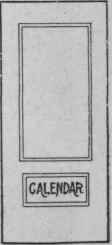
Typical Arrangement Of Mount.
231. Desk Blotters.
Blotting paper, 1 piece, 9"x 12". Heavy cover paper, 1 piece, 6"x 9". Long narrow pictures, 2, about 1 1/2"x 5 1/2". Paste, colored cord (or narrow ribbon). Rule, pencil, scissors, punch.
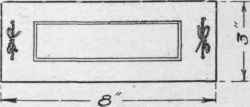
Blotters Tied Under Cover.
Directions: a. Cut four pieces of blotting paper each 3"x 8".
b. Cut two pieces of heavy cover paper each 3"x8".
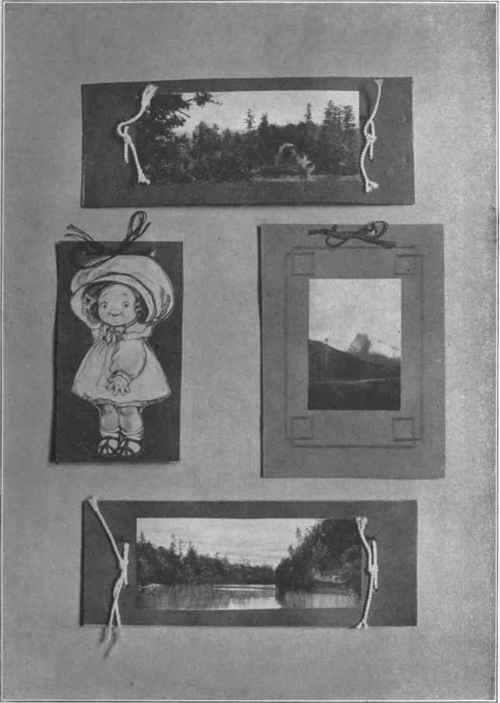
Desk Blotters c. Punch holes at each end and tie one piece of cover paper over two pieces of blotting paper with colored cord or narrow ribbon; make two models.
d. Trim pictures to desired size and paste in place.
Note: - One of these may be used by the pupil, and the other used as a gift, or saved for exhibit purposes.
232. Photo Mount.
Heavy cover paper, 1 piece, 6"x 9".
Unmounted photograph or small colored poster or a colored magazine illustration. A black and white half-tone or line drawing will do if nothing else be available.
Paste.
Scissors.
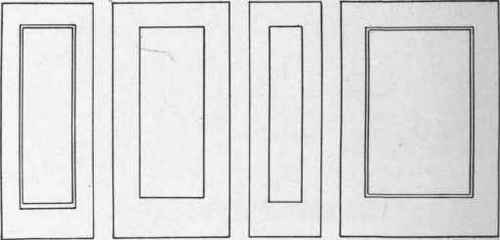
Suggestions For Proportion In Mounting Panel Pictures.
Directions: a. Cut out picture.
b. Select suitable color in mounting paper. Dark colors can best be used with photographs and with colored pictures. White and lighter colors are suitable for line drawings and halftones. Gray is more likely to be used successfully than any other color. Black may be used in place of dark colors.
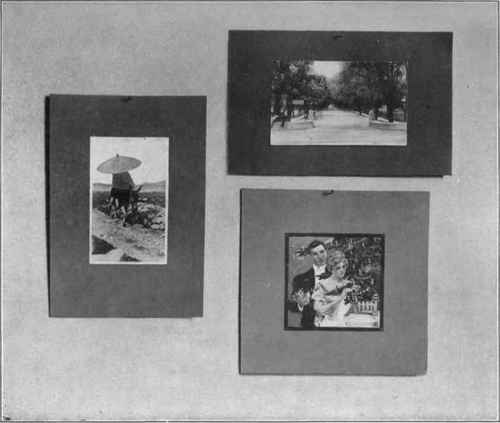
Picture Mounts Card Problems c. Cut mount in good proportion and paste. Get variation in sizes, and have bottom margin larger than side margin. Avoid overcrowding and too striking contrasts.

Other Suggestions For Mounting.
Note: - In case there are any especially good pictures, they may be mounted first upon paper with a narrow margin and then mounted upon the larger mount as illustrated in the left and right drawings.
233. Glass Cover.
Heavy tag board, I piece, 6"x9".
Rule, pencil, scissors (also compass if available).
6"x9" Stock Laid Out.
Marking Octagon.
Completed Covers.
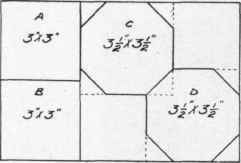
Directions: a. Lay out from drawing. Make A and B 3" square, make 3 1/2" square, next to A and at the top of card, make D 3 1/2" square, from lower right corner of card.
b. Cut out A, B, C, and D. A and B are to be cut into regular octagons later, C and D will remain only approximately regular.
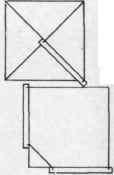
Card Problems c. Lay out square A as a regular octagon from second drawings. Draw diagonals and measure distance from corner to center with strip of paper or tag board, lay this out from each corner along adjacent sides as shown for one corner in the drawing, connect the points as indicated, cut off corners.
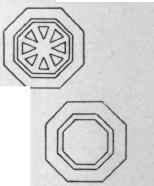
d. Decoration by means of border lines or simple center pattern may be added.
Note: - A convenient use for this model is to cover a glass of liquid, which for any reason, as for sickness, must remain for a time unused. If compasses be available, the octagon may be laid out more easily by swinging the distances from the corner with them. In place of an octagonal cover, a circular one may be made with a radius of 1 1/2" or 1 3/4". The decorations may be made with a brush and water color or with pen and ink or with pencil.
331. Post Card.
Medium or heavy tag board, 1 piece, 6"x 9". Rule, pencil, scissors.

Three Styles Of Post Card 3 1/4"x 5 1/2"
Directions: a. Lay out and cut to size one or two cards. Sizes may vary from 3"x 5" to 3 1/2"x 6".
b. Put border along top or around the card with rule and pencil. Pen and ink or water color may be used in place of pencil.
c. Address the card to self or to a friend. If to be used to send a message to a friend, the note may be written and the stamp affixed in class, and information given regarding postal rates and the postal system.
332. Page Holder.
Heavy cover paper, 1 piece, 6"x 9" (or 3" x6"). Rule, pencil, scissors, punch. A few punches will be enough for the whole class.
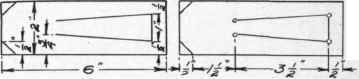
2"x 6" Stock Laid Out.
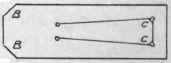
Finished Piece.
Directions: a. Lay out vertical measurements. See first drawing.
b. Lay out horizontal measurements and punch four holes as illustrated. See second drawing.
c. Cut inside lines for tab, cut corners from tab at C C, and cut outside corners B B. See last drawing.
Continue to:


My Books

