


IV. Card Problems
Description
This section is from the book "Paper and Cardboard Construction", by G. F. Buxton, F. L. Curran. Also available from Amazon: Paper and cardboard construction.
IV. Card Problems
Card mounts furnish a good field for a study of proportion in simple and effective arrangements of rectangular shapes, and they give a good place for the study of color relations. In the study of pictures an interest is added in the making of suitable mounts. In some cases pictures suitable for framing may be mounted by the children. This mounting work may be handled as a subject by itself, and pictures supplied as needed, or in connection with the work in drawing and art study. In many cases the drawings of the children are good subjects for mounting.
A frequent demand for proper mounts for illustrative matter such as grasses and samples of papers and fabrics is met by having mounts of heavy material made as needed. Magazine illustrations related to school subjects furnish endless features proper for mounting in the handwork class. Mounts of uniform size for filing enable the teacher or pupil to have available at all times supplementary illustrations of interesting details of school work. The blue-prints and charts mentioned in the note number 433 are especially valuable both as exercises and finished products. While the cutting and placing of pictures and illustrative material do not require much calculation or difficult manipulation, they do require care and accurate judgment and neat workmanship and so have a place in a primary handwork course.
Besides the making of mounts, whether of heavy cover paper or mounting boards, there are many other problems which may be grouped as card problems, to be made of tag board and heavy cover papers. These are arranged in places in the school where they can be handled successfully, and it will be seen that they give a good drill upon careful measuring and cutting to the line. The list may be extended indefinitely, especially if compasses be available. The extensive use of the compass is not advised where the pupils are required to make their own designs as they can seldom produce good outlines based upon compass curves.
The arrangement of card problems and materials by grades is as follows:
131 Mounted drawings (Heavy cover paper, gray drawing paper).
132 Book marks (Medium tag board).
133 Calendar (Heavy cover paper or mounting board).
231 Desk blotters (Blotting paper and heavy cover paper).
232 Photo mount (Heavy cover paper).
233 Glass cover (Heavy tag board).
331 Post card (Medium or heavy tag board).
332 Page holder (Heavy cover paper).
333 Shipping tags (Heavy tag board).
Fourth Grade
431 Postal scale (Marble board and bristol board).
432 Folder picture mount (Heavy cover paper or mounting board).
433 Desk pad (Strawboard, heavy cover paper, thin cover paper).
131. Mounted Drawings.
Heavy cover paper, 1 piece, 9"x 12".
Gray drawing paper, 1 piece, 9"x 12".
Paste.
Rule, pencil, crayon, scissors.
Directions: a. Cut two or more mounts from the 9"x 12" sheet of heavy cover or mounting paper. In the cut is shown how four mounts of different sizes and shapes may be cut from the large sheet.
b. Cut as many pieces of drawing paper as there are mounts.
Each piece of drawing paper should be of such size Card Problems and shape as will look well when mounted.
c. Make drawings on the pieces of drawing paper.
d. Mount drawings by fastening the two upper corners with a little paste.
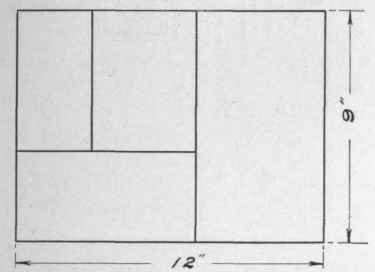
One Possibility For Four Mounts.
Note: - The teacher may determine the number, size, and shape of the mounts. The pupils have a chance to study, under the teacher's direction, the size and proportion of the pieces of drawing paper when these are being cut to size. Color is important here. To simplify matters for public school work the mounting paper may be of a medium or dark gray and the drawing paper of a lighter gray. The same idea works out well in tones of brown.
The directions given above may be reversed and, after drawings are made and drawing paper cut, the mounts may be made of suitable size and proportion to fit the drawings.
132. Book-marks.
Medium tag board, 1 piece, 6"x 9". Rule, pencil, scissors.
Directions: a. The teacher should determine beforehand several rectangular shapes which can be cut from the 6"x 9" piece. Four pieces of different sizes and shapes are shown in the drawings.
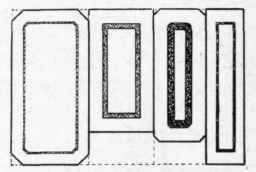
Four Book-marks From 6"x9" Stock.
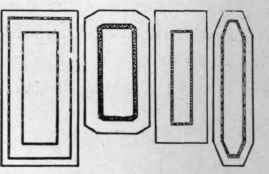
Same Pieces With Other Borders b. Have the pupils lay off on the piece of tag board, shapes as nearly as possible like those shown by the teacher. This laying out is done without measuring. The teacher should indicate the method of procedure by making a drawing on the blackboard.
c. After all the pieces are cut to the desired rectangular shapes, lines are drawn across the corners with the rule to indicate the parts to be cut away.
d. Some simple line or band decorations may be put on with pencil or crayon.
Note: - In place of following the teacher's arrangement of shapes from a blackboard drawing, pupils may be encouraged to make their own designs and border decoration. In some cases other forms of decoration may be attempted, if the teacher be competent to set adequate limitations.
133. Calendar.
Heavy cover paper, or heavy mounting paper, I piece, 6"x 9". Calendar about 1 1/4"x 2". Picture, - half-tone or photograph. Paste. Rule, pencil, scissors.
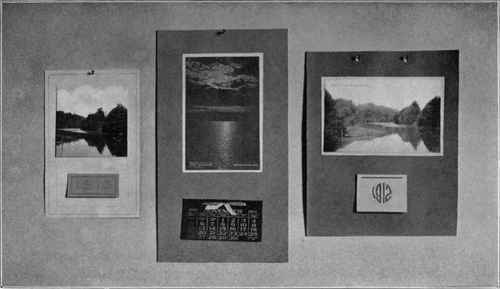
Calendars Mounted With Photographs.
Directions: a. Cut mount to size and shape which is determined by the size and shape of the picture combined with the size and shape of the calendar pad.
Continue to:


My Books

