


Chapter II. Method Of Presentation
Description
This section is from the book "Paper Folding And Cutting", by Katherine M. Ball. Also available from Amazon: Paper folding and cutting.
Chapter II. Method Of Presentation
THIS work is intended to follow the simple outline for folding found in "The Prang Primary Manual," therefore it is unnecessary to go into detail as to preliminary exercises.
The children, having learned to fold edge to edge and corner to corner, having bisected, trisected, and quadrisected paper by folding, are now ready to take up the construction of geometric figures,, stars, rosettes, and borders.
The method of presentation embraces dictation, imitation, and imagination.
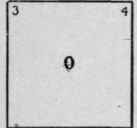
Fig. I 2
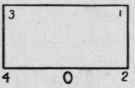
Fig.2

FiG.3

Fig. 4
With the square in the hands of the children, they bisect it by folding 1-2 on 3-4, as in Fig. 1, obtaining Fig. 2. Again they bisect Fig. 2 by folding 1-2 on 3-4, obtaining Fig. 3.
Holding Fig. 3 by the closed corner (which is the centre of the original square) in the left hand, ask the children what kind of a figure they would get by cutting a curved line, concave to the centre of the square or curving outward, connecting points 1 and 2.
After they have worked upon their imagination for the result, let them make the trial, comparing results. Next ask them to tell you what kind of a figure they would get by connecting 1-2 with a curved line curving inward.
They may not be able to describe it in words, but may make a simple drawing on their slates or paper. Have them make the cut and again compare results. They may then in like manner connect 1 and 2 with a straight line.
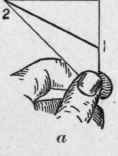
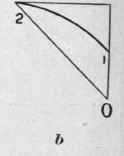
They may now fold to Fig. 4, page 11. By folding to Fig. 3 and then folding 1 on 2, they will get Fig. 4. Reversing it and holding the fold at the original square's centre, 0, what will they get by cutting a straight line from 1 to 2, as a ? or a curved line, as b ?
Both exercises may be cut.
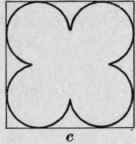
Now ask the children how many can fold and cut a figure from a drawing on the board. Draw the quatrefoil c, page 13, on the board, and let the children make the trial.
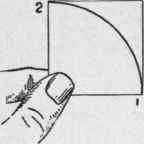
Those who fail may be assisted in this manner: Give them a fresh square and ask them to draw the quatrefoil upon it; then fold to Fig. 4, keeping the drawn lines on top.
Ask the children what the repeating unit is. (A circle.) Ask how much of the repeating unit can be seen on the fold. (Half.) By cutting on the drawn line, they will get the figure.
If the fold is not held at the closed corner, o, when cutting, the children may be much surprised to find they have a number of small, meaningless pieces of paper instead of a completed figure. A little experience will soon correct this.
Figures like those at the right may be put on the board, which the children may make.
Frequently the children will get a fair imitation of the drawing, yet their proportion of parts may be such as to make an undesirable result. Then it will be necessary to lead them to analyze the drawing, to enable them to more closely observe it. For instance, in the quatrefoil, ask, What kind of curves are to be found ? Where does the curve begin and where does it end ? At what point on the diameter do the curves meet, and what kind of an angle do they make ? How near the corner of the square does the curve come ? etc.
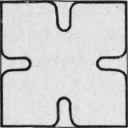
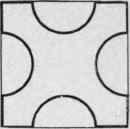
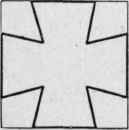
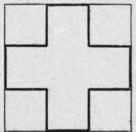
After a series of such questions, have the children make a second or a third trial, until they get something which is satisfactory.
The folding and cutting do not consume much time; for this reason it will be found that the children can accomplish more by cutting than by drawing in the given time.
Figures Having Three Or Six Parts
In taking up figures having three or six parts, we must show the children that, in order to get three or six parts, the whole square must first be divided into three or six parts.

Fig. I
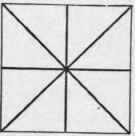
Thus far the children have divided the paper by bisecting or trisecting the sides and connecting points of division, as Fig. 1. Now we want a division which is made by lines radiating from the centre, as Fig. 2. In Fig. 1, we divide the space into parts having equal size and shape; in Fig. 2, we divide the space so that the angles at the centre of the square will be equal.
It is a very easy matter to make a division having eight equal angles, as all it requires is to fold diameters and diagonals ; but one having three or six is much more difficult.
As six embraces three, we will take six first. Ask the children to make a trial, first placing a point in the centre of the square, and drawing the division lines radiating from it, as a.
Have them test the accuracy by folding 1 on 2, and then into thirds, to see if the parts are equal.
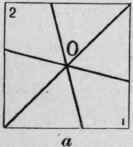
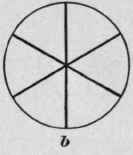
If it is found that the division of the square is too difficult, try the circle, as b, in a similar manner. Inasmuch as the radiating lines will be of the same length, it may be better understood.
It will now be an easy matter to lead them to the folds as given for all three and six leaved rosettes.
Figures Having Five Parts
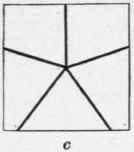
For figures having five parts, the square must be divided into five parts, the dividing lines radiating from the centre and making the five central angles the same, as c.
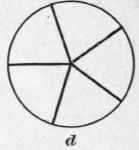
If the children cannot comprehend this, have them use a circle, as d, and it may be simpler. Then try the division of the square afterwards.
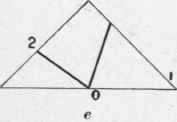
If the whole square is divided into five parts, the half square must be divided into two parts and a half, as c. It will now be an easy matter, folding from o, to fold 1 on 2, and the remaining half part underneath, thus giving us the fold for five-leaved rosettes.
Continue to:


My Books

