


Chapter III. The Evolution Of Units And Their Application In Design
Description
This section is from the book "Paper Folding And Cutting", by Katherine M. Ball. Also available from Amazon: Paper folding and cutting.
Chapter III. The Evolution Of Units And Their Application In Design
THE general proportion and the simple and shapely outline of the kite make it the type for many figures used as repeats in design; any slight modification of its outline will produce a new figure, as shown in these illustrations: -


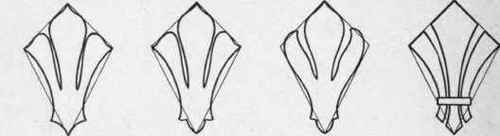

In the kite, and the units based on it,1 we find the greatest width above the centre.
1 This " Evolution of Units " is taken from " The Prang Course in Drawing."
There are other pleasing historic repeats, in which the greatest width is below the centre. Examples of the kind are given in these illustrations : -


The upper and lower rows are Moorish ; the middle row is Gothic.
In exercises in invention, have the child modify the kite, making his own unit and applying it to the different geometric figures. While the same unit may be used for all the designs, its adaptation to the spaces of the different figures must necessarily change its proportions, making it wider, as in the square, and very much narrower, as in the octagon.
Inferring that the child has modified the kite into this unit, a, he may fold the square, from which the design is to be cut, to Fig. 4 of Chapter II (Method Of Presentation)., and draw on it half of the unit, as b. If he should cut from o through I to 3, his result would be four separate pieces, as there would be nothing to hold it together at the centre; but, by cutting from 1 to 2, point 2 being the tangential union of the lines 2-1 and 0-3, the design will be complete, as c.
He will now be interested to see the effect of the repetition of this unit in the octagon, the triangle, the hexagon, and the pentagon, as illustrated in Figs. 1, 2, 3, 4, page 19.
For the octagon, he must fold to Fig. 5 of Chapter IV (Foldings And Cuttings From The Square And Circle).; for the triangle, to Fig. 4 of Chapter V (Foldings And Cuttings From The Square And Circle. - Continued).; for the hexagon, to Fig. 5 of Chapter V. ; and for the pentagon, to Fig. 5 of Chapter VI (Foldings And Cuttings From The Square And Circle. - Continued).; always making the drawing of the half unit comfortably fill the space on the fold.
Should the child use for his design a unit that in itself would not make a centre, he would have to provide for this in his drawing on the fold. For instance, in selection a, which is the kite, should he cut on the entire outline, his design would fall apart; but by drawing a centre on it, as in 1-2 in b, and cutting from 3 to 2 and 2 to 1, as in c, he will then have a centre which holds the units together, and his design will be complete.


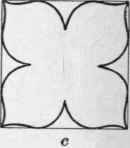

Fig. I.

Fig. 2.

Fig. 3.

Fig. 4.


Continue to:


My Books

