


II. The Equilateral Triangle
Description
This section is from the book "Geometric Exercises In Paper Folding", by Tandalam Sundara Row . Also available from Amazon: T. Sundara Row's Geometric Exercises in Paper Folding (Large Print Edition).
II. The Equilateral Triangle
22. Now take this square piece of paper (Fig. 9), and fold it double, laying two opposite edges one upon the other. We obtain a crease which passes through the mid-points of the remaining sides and is at right angles to those sides. Take any point on this line, fold through it and the two corners of the square which are on each side of it. We thus get isosceles triangles standing on a side of the square.

Fig. 9.
23. The middle line divides the isosceles triangle into two congruent right-angled triangles.
24. The vertical angle is bisected.
25. If we so take the point on the middle line, that its distances from two corners of the square are equal to a side of it, we shall obtain an equilateral triangle (Fig. 10). This point is easily determined by turning the base AB through one end of it, over A A', until the other end, B, rests upon the middle line, as at C. 26. Fold the equilateral triangle by laying each of the sides upon the base. We thus obtain the three altitudes of the triangle, viz.: A A', BB', CC', (Fig. 11).
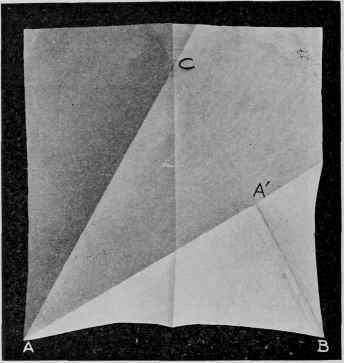
Fig. 10.
27. Each of the altitudes divides the triangle into two congruent right-angled triangles.
28. They bisect the sides at right angles.
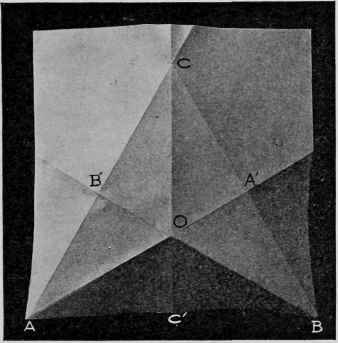
29. They pass through a common point.
30. Let the altitudes AA' and CC meet in O. Draw BO and produce it to meet AC in B'. BB' will now be proved to be the third altitude. From the triangles CO A and CO A', OC' = OA'. From triangles OC'B and A'OB, OBC'=
OBC'= A'BO. Again from triangles ABB' and CB'B,
 AB'B=
AB'B= BB'C, i. e., each of them is a right angle. That is, BOB' is an altitude of the equilateral triangle ABC. It also bisects AC in B'.
Fig. 11.
31. It can be proved as above that OA, OB, and OC are equal, and that OA', OB', and OC are also equal.
32. Circles can therefore be described with O as a center and passing respectively through A, B, and C and through A', B', and C. The latter circle touches the sides of the triangle.
33. The equilateral triangle ABC is divided into six congruent right-angled triangles which have one set of their equal angles at 0, and into three congruent, symmetric, concyclic quadrilaterals.
34. The triangle AOC is double the triangle A'OC; therefore, AO = 20A'. Similarly, BO = 20B' and C0 = 20C Hence the radius of the circumscribed circle of triangle ABC is twice the radius of the inscribed circle.
35. The right angle A, of the square, is trisected by the straight lines AO, AC. Angle BAC = 2/3 of a right angle. The angles C'AO and OAB' are each 1/3 of a right angle. Similarly with the angles at B and C.
36. The six angles at 0 are each 2/3 of a right angle.
37. Fold through A'B', B'C, and C'A' (Fig. 12). Then A'B'C is an equilateral triangle. It is a fourth of the triangle ABC.
38. A'B', B'C, C'A' are each parallel to AB, BC, CA, and halves of them.
39. AC'A'B' is a rhombus. So are C'BA'B' and CB'C'A'.
40. A'B', B'C, C'A' bisect the corresponding altitudes.
41. CC'2+AC'2 = CC'2+¼AC2=AC2
.˙. CC'2 = ¾AC2 .˙. CC = ½√3. AC=½√3. AB
= 0.866....X AB.
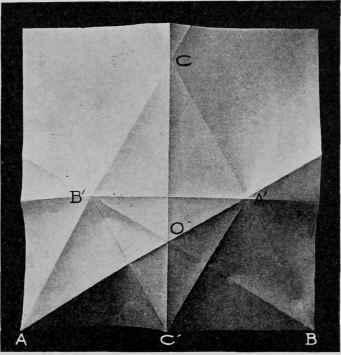
Fig. 12.
42. The A ABC = rectangle of AC and CC', i. e. ½AB X √3. AB = ¼√3.AB2 = 0.433.... XAB2.
43. The angles of the triangle AC'C are in the ratio of 1:2:3, and its sides are in the ratio of √1 : √3 : √4.
Continue to:


My Books

