


III. Squares And Rectangles
Description
This section is from the book "Geometric Exercises In Paper Folding", by Tandalam Sundara Row . Also available from Amazon: T. Sundara Row's Geometric Exercises in Paper Folding (Large Print Edition).
III. Squares And Rectangles
44. Fold the given square as in Fig. 13. This affords the well-known proof of the Pythagorean theorem. FGH being a right-angled triangle, the square on FH equals the sum of the squares on FG and GH.

Fig. 13.
 FA+
FA+ DB=
DB= FC.
FC.
It is easily proved that FC is a square, and that the triangles FGH, HBC, KDC, and FEK are congruent.
If the triangles FGH and HBC are cut off from the squares FA and DB, and placed upon the other two triangles, the square FHCK is made up. If AB = a, GA=b, and FH=c, then a2 + b2 = c2.

Fig. 14.
45. Fold the given square as in Fig. 14. Here the rectangles AF, BG, CH, and DE are congruent, as also the triangles of which they are composed. EFGH is a square as also KLMN.
Let AK=a, KB = b, and NK = c, then a2 + b2 = c2, i. e. KLMN.
KLMN.

Now square ABCD overlaps the square KLMN by the four triangles AKN, BLK, CML, and DNM.
But these four triangles are together equal to two of the rectangles, i. e., to 2ab.
Therefore (a + b)2 = a2 + b2 + 2ab.
46. EF=a - b, and EFGH=(a - b)2.
The square EFGH is less than the square KLMN by the four triangles .FNK, GKL, HLM, and EMN.
But these four triangles make up two of the rectangles, i. e., 2ab.
... (a - b)2 = a2 + b2 - 2ab.

Fig. 15
47. The square ABCD overlaps the square EFGH by the four rectangles AF, BG, CH, and DE.
... (a + b)2 - (a - b)2 = 4ab.
48. In Fig. 15, the square ABCD=(a + b)2, and the square EFGH=(a - b)2. Also square AKGN = square ELCM = a2. Square KBLF = square NHMD = b2.
Squares ABCD and EFGH are together equal to the latter four squares put together, or to twice the square AKGN and twice the square KBLF, that is, (a + b)2 + (a - b)2 = 2a2 + 2b2.
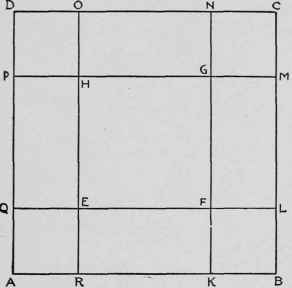
Fig. 16.
49. In Fig. 16 the rectangle PL is equal to (a + b) (a - b).
Because the rectangle EK = FM, therefore rectangle PL - square PK - square AE, i. e., (a + b) (a - b) = a2 - b2.
50. If squares be described about the diagonal of a given square, the right angle at one corner being common to them, the lines which join this corner with the mid-points of the opposite sides of the given square bisect the corresponding sides of all the inner squares. (Fig. 17.) For the angles which these lines make with the diagonal are equal, and their magnitude is constant for all squares, as may be seen by superposition. Therefore the mid-points of the sides of the inner squares must lie on these lines.

Fig. 17.
51. ABCD being the given square piece of paper (Fig. 18), it is required to obtain by folding, the point X in AB, such that the rectangle AB.XB is equal to the square on AX.
Double BC upon itself and take its mid-point E.
Fold through E and A.
Lay EB upon EA and fold so as to get EF, and G such that EG = EB.
Take AX= AG.
Then rectangle AB.XB = AX2. Complete the rectangle BCHX and the square A XKL.
Let XH cut EA in M. Take FY=FB. Then FB = FG = FY = XM and XM= ½AX.
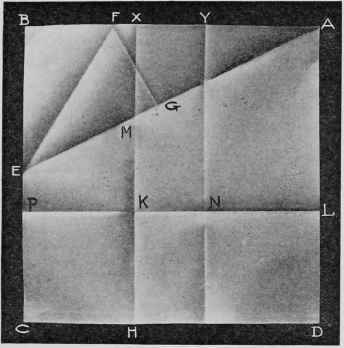
Fig. 18.
Now, because BY is bisected in F and produced to A,
AB.AY+FY2 = AF2, by § 49,
= AG2 + FG2, by § 44. ... AB.AY=AG2, = AX2. But AX2 = 4.XM2 = BY2.
... AX=BYand AY=XB.
... AB.XB = AX2.
AB is said to be divided in X in median section.*
Also
AB.AY=BY2 i. e., AB is also divided in Y in median section.
52. A circle can be described with F as a center, its circumference passing through B, G, and Y. It will touch EA at G, because FG is the shortest distance from F to the line EGA.
53. Since
BH=BN, subtracting BK we have rectangle XKNY= square CHRP, i. e., AX.YX=AY2, i. e., AX is divided in Fin median section.
Similarly BY is divided in X in median section.
54. ... AB.XB = AX2
... 3AB.XB = AX2 + BX.BC+ CD.CP = AB2 + BX2
55. Rectangles BH and YD being each =AB.XB, rectangle HY+ square CK= AX2 = AB.XB.
56. Hence rectangle HY= rectangle BK, i. e., AX.XB = AB.XY
57. Hence rectangle HN=AX.XB - BX2.
*The term "golden section" is also used. See Beman and Smith's New Plane and Solid Geometry, p. 196.
58. Let AB = a, XB = x.
Then (a - x)2 = ax, by § 51. a2 + x2 = 3ax, by § 54; ... x2 - 3ax + a2 = 0 and x = a/2 (3 - √5). ...x2 = a2 / 2(7 - 3√5).
... a - x = a/2 (√5 - l) = a X 0.6180....
... (a - x)2 = a2 / 2 (3 - √5) = a2 X 0.3819....
The rect. BPKX
= (a - x)x
= a2 (√5 - 2) = a2 X 0.2360....
EA2 = 5EB2 = 5/4 AB2.
EA = √5 /2 AB = 1.1180.... X a.
59. In the language of proportion
AB : AX = AX : XB.
The straight line AB is said to be divided "in extreme and mean ratio."
60. Let AB be divided in X in median section. Complete the rectangle CBXH (Fig. 19). Bisect the rectangle by the line MNO. Find the point N by laying XA over X so that A falls on MO, and fold through XN, NB, and NA. Then BAN is an isosceles triangle having its angles ABN and BNA double the angle NAB.
AX=XN=NB
 ABN=
ABN= NXB
NXB
 NAX=
NAX= XNA
XNA
 NXB = 2,
 NAX
NAX
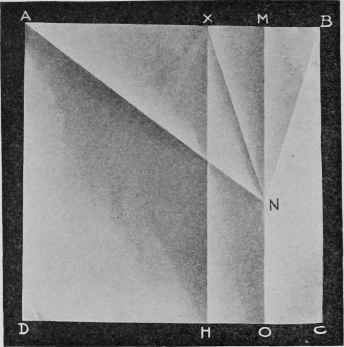
Fig. 19.
 ABN= 2
 NAB.
NAB.
AN2 = MN2 + AM2
= BN2 - BM2 + AM2 = AX2 + AB.AX = AB.XB + AB.AX = AB2
... AN=AB and NAB = 2/5 of a right angle.
61. The right angle at A can be divided into five equal parts as in Fig. 20. Here N' is found as in §60. Then fold AN'Q; bisect QAB by folding, fold over the diagonal AC and thus get the point Q', P'.
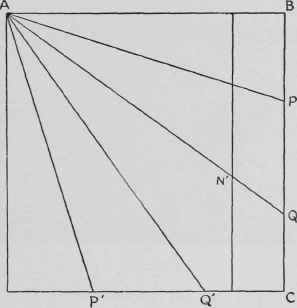
Fig. 20.
62. To describe a right-angled triangle, given the hypotenuse AB, and the altitude.
Fold EF (Fig. 21) parallel to AB at the distance of the given altitude.
Take G the middle point of AB. Find H by folding GB through G so that B may fall on EF.
Fold through H and A, G, and B. AHB is the triangle required.
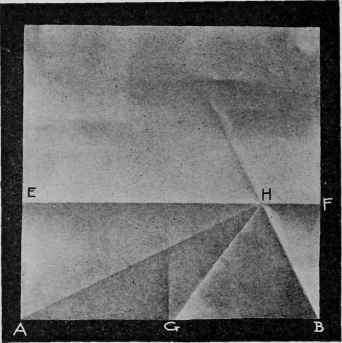
Fig. 21.
63. ABCD (Fig. 22) is a rectangle. It is required to find a square equal to it in area.

Fig. 22.
Mark off BM=BC.
Find O, the middle point of AM, by folding.
Fold OM, keeping 0 fixed and letting M fall on line BC, thus finding P, the vertex of the right-angled triangle AMP.
Describe on PB the square BPQR.
The square is equal to the given rectangle.
For ...BP = QP, and the angles are equal, triangle BMP is evidently congruent to triangle QSP.
... QS=BM=AD.
... triangles DA T and QSP are congruent.
... PC=SR and triangles PSA and CPT are congruent.
 ABCD can be cut into three parts which can be fitted together to form the square RBPQ.

Fig. 23.
64. Take four equal squares and cut each of them into two pieces through the middle point of one of the sides and an opposite corner. Take also another equal square. The eight pieces can be arranged round the square so as to form a complete square, as in Fig. 23, the arrangement being a very interesting puzzle.
The fifth square may evidently be cut like the others, thus complicating the puzzle.
65. Similar puzzles can be made by cutting the squares through one corner and the trisection points of the opposite side, as in Fig. 24.
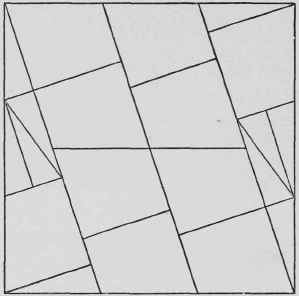
Fig. 24.
66. If the nearer point is taken 10 squares are required, as in Fig. 24 ; if the remoter point is taken 13 squares are required, as in Fig. 25.
67. The puzzles mentioned in §§ 65, 66, are based upon the formulas
12 + 22 = 5
12 + 32 = 10 22 + 32 = 13.
The process may be continued, but the number of squares will become inconveniently large.
68. Consider again Fig. 13 in § 44. If the four triangles at the corners of the given square are removed, one square is left. If the two rectangles FK and KG are removed, two squares in juxtaposition are left.

Fig. 25.
69. The given square may be cut into pieces which can be arranged into two squares. There are various ways of doing this. Fig. 23, in § 65, suggests the following elegant method: The required pieces are (1) the square in the center, and (2) the four congruent symmetric quadrilaterals at the corners, together with the four triangles. In this figure the lines from the mid-points of the sides pass through the corners of the given square, and the central square is one-fifth of it. The magnitude of the inner square can be varied by taking other points on the sides instead of the corners.
70. The given square can be divided as follows (Fig. 26) into three equal squares :
Take BG = half the diagonal of the square.
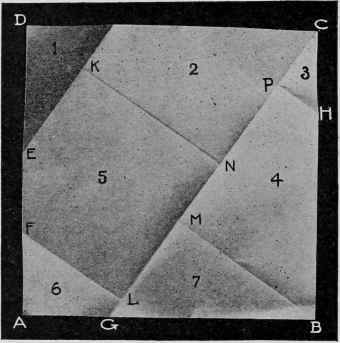
Fig. 26.
Fold through C and G. Fold BM perpendicular to CG. Take MP, CN, and NL each = BM. Fold PH, NK, LF at right angles to CG, as in Fig. 26.
Take NK = BM, and fold KE at right angles to NK.
Then the pieces 1, 4, and 6, 3 and 5, and 2 and 7 form three equal squares.
Now CG2 = 3BG2, and from the triangles GBC and CMB
BM / BC = BG / CG;
Letting BC=a, we have
BM = a/√3.
Continue to:


My Books

