


IV. The Pentagon
Description
This section is from the book "Geometric Exercises In Paper Folding", by Tandalam Sundara Row . Also available from Amazon: T. Sundara Row's Geometric Exercises in Paper Folding (Large Print Edition).
IV. The Pentagon
71. To cut off a regular pentagon from the square ABCD.
Divide BA in X in median section and take M the mid-point of AX.
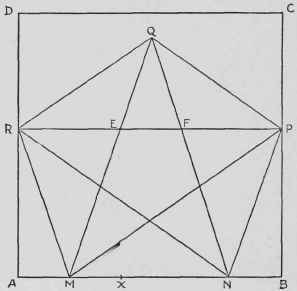
Fig. 27.
Then AB.AX=XB2, and AM=MX. Take BN=AM or MX. Then MN=XB.
Lay off NP and MR equal to MN, so that P and R may lie on BC and AD respectively.
Lay off RQ and PQ = MR and NP.
MNPQR is the pentagon required.
In Fig. 19, p. 22, AN, which is equal to AB, has the point N on the perpendicular MO. If A be moved on AB over the distance MB, then it is evident that N will be moved on to BC, and X to M.
Therefore, in Fig. 27, NR = AB. Similarly MP = AB. RP is also equal to AB and parallel to it.
 RMA = 4/5 of a rt.
... NMR = 6/5 of a rt
 .
.
Similarly PNM= 6/5 of a rt.
 .
.
From triangles MNR and QRP, NMR=
NMR= RQP = 6/5 of a rt.
The three angles at M, N, and Q of the pentagon being each equal to 6/5 of a right angle, the remaining two angles are together equal to 12/5 of a right angle, and they are equal. Therefore each of them is 6/5 of a right angle.
Therefore all the angles of the pentagon are equal. ,
The pentagon is also equilateral by construction.
72. The base MN of the pentagon is equal to XB, i. e., to AB/2 (√5 - 1) =AB X 0.6180.... § 58.
The greatest breadth of the pentagon is AB.
73. If p be the altitude,
AB2 = P2 +

=p2 + AB2 • 3 - √5 / 8.
... p2 = AB2

=AB2.5 + √5 / 8.
... p = AB •

= AB X 0.9510....= AB cos 18°.

Fig. 28.
74. If R be the radius of the circumscribed circle,


= AB X 0.5257....
75. If r be the radius of the inscribed circle, then from Fig. 28 it is evident that r=p - R = AB. - AB.
- AB.
= AB.
= AB.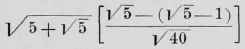
= AB.
= AB X 0.4253....
76. The area of the pentagon is 5r X ½ the base of the pentagon, i. e.,
5AB. .AB/4.(√5-1)
= AB2.5/4. = AB2 X 0.6571....
77. In Fig. 27 let PR be divided by MQ and NQ in E and F.
Then ... MN = AB/2 • (√5 - 1) ... § 72 and cos 36°= ½ AB / ½ AB.(√5 - 1),
... RE = FP = MN/2 . 1/cos 36° = AB.√5 - 1 / √5+1
=AB.3 - √5 /2....(1)
EF=AB - 2RE = AB - AB(3 - √5)
= AB(√5 - 2)... (2) RF=MN.
RE: RE = RE : EF(by § 51)....................(3)
√5 - 1 : 3 - √5 = 3 - √5:2(√5 - 2)...........(4)
By § 76 the area of the pentagon
=AB2.5/4.
=MN2. .5/4.
.5/4.
=MN2. 1/4. since AB = MN • √5 + 1 / 2.
... the area of the inner pentagon
= EF2.1/4
= AB2 . (√5 - 2)2 • 1/4.
The larger pentagon divided by the smaller
= MN2 : EF2 = 2 : (7 - 3√5)
= 1 : 0.145898.. ..
78. If in Fig. 27, angles QEK and LFQ are made equal to ERQ or FQP, K, L being points on the sides QR and QF respectively, then EFLQK will be a regular pentagon congruent to the inner pentagon. Pentagons can be similarly described on the remaining sides of the inner pentagon. The resulting figure consisting of six pentagons is very interesting.
Continue to:


My Books

