


X. Series
Description
This section is from the book "Geometric Exercises In Paper Folding", by Tandalam Sundara Row . Also available from Amazon: T. Sundara Row's Geometric Exercises in Paper Folding (Large Print Edition).
X. Series
Arithmetic Series
102. Fig. 40 illustrates an arithmetic series. The horizontal lines to the left of the diagonal, including the upper and lower edges, form an arithmetic series.
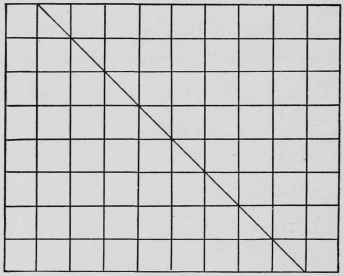
Fig. 40.
The initial line being a, and d the common difference, the series is a, a + d, a + 2d, a + 3d, etc.
103. The portions of the horizontal lines to the right of the diagonal also form an arithmetic series, but they are in reverse order and decrease with a common difference.
104. In general, if / be the last term, and s the sum of the series, the above diagram graphically proves the formula s= n/2 (a + l).
105. If a and c are two alternate terms, the middle term is a + c / 2.
106. To insert n means between a and l, the vertical line has to be folded into n + 1 equal parts. The common difference will be l - a / n+1.
107. Considering the reverse series and interchanging a and l, the series becomes a, a - d, a - 2d.. .. l.
The terms will be positive so long as a > (n - 1)d, and thereafter they will be zero or negative.
Geometric Series
108. In a right-angled triangle, the perpendicular from the vertex on the hypotenuse is a geometric mean between the segments of the hypotenuse. Hence, if two alternate or consecutive terms of a geometric series are given in length, the series can be determined as in Fig. 41. Here OP1, OP2, OP3, OP4, and OP5 form a geometric series, the common rate being OP1 : OP2.

Fig. 41.
If OP1 be the unit of length, the series consists of the natural powers of the common rate.
109. Representing the series by a, ar, ar2,....
P1P2 =
P2P3 =
P3P4 =
These lines also form a geometric series with the common rate r. no. The terms can also be reversed, in which case the common rate will be a proper fraction. If OP5 be the unit, OP4, is the common rate. The sum of the series to infinity is
OP5 / OP5 - OP4.
111. In the manner described in § 108, one geometric mean can be found between two given lines, and by continuing the process, 3, 7, 15, etc., means can be found. In general, 2n - 1 means can be found, n being any positive integer.
112. It is not possible to find two geometric means between two given lines, merely by folding through known points. It can, however, be accomplished in the following manner : In Fig. 41, OP1 and OP4 being given, it is required to find P2 and P3. Take two rectangular pieces of paper and so arrange them, that their outer edges pass through P1 and P4, and two corners lie on the straight lines OP2 and OP3 in such a way that the other edges ending in those corners coincide. The positions of the corners determine OP2 and OP3.
113. This process gives the cube root of a given number, for if OP1 is the unit, the series is 1, r, r2, r3.
114. There is a very interesting legend in connection with this problem.* "The Athenians when suffering from the great plague of eruptive typhoid fever in 430 B. C, consulted the oracle at Delos as to how they could stop it. Apollo replied that they must double the size of his altar which was in the form of a cube. Nothing seemed more easy, and a new altar was constructed having each of its edges double that of the old one. The god, not unnaturally indignant, made the pestilence worse than before. A fresh deputation was accordingly sent to Delos, whom he informed that it was useless to trifle with him, as he must have his altar exactly doubled. Suspecting a mystery, they applied to the geometricians. Plato, the most illustrious of them, declined the task, but referred them to Euclid, who had made a special study of the problem." (Euclid's name is an interpolation for that of Hippocrates.) Hippocrates reduced the question to that of finding two geometric means between two straight lines, one of which is twice as long as the other. If a, x, y and 2a be the terms of the series, x3 = 2a3. He did not, however, succeed in finding the means. Menaechmus, a pupil of Plato, who lived between 375 and 325 B. C, gave the following three equations: * a : x = x : y=y : 2a. From this relation we obtain the following three equations : x2 = ay ..................(1) y2 = 2ax..................(2) xy = 2a2..................(3)
*But see Beraan and Smith's translation of Fink's History of Mathematics, p. 82, 207.
(1) and (2) are equations of parabolas and (3) is the equation of a rectangular hyperbola. Equations (1) and (2) as well as (1) and (3) give x3=2a3. The problem was solved by taking the intersection (a) of the two parabolas (1) and (2), and the intersection (β) of the parabola (1) with the rectangular hyperbola (3).
* Ibid., p. 207.
Harmonic Series
115. Fold any lines AR, PB, as in Fig. 42, P being on AR, and B on the edge of the paper. Fold again so that AP and PR may both coincide with PB. Let PX, PY be the creases thus obtained, X and Y being on AB.
Then the points A, X, B, Y form an harmonic range. That is, AB is divided internally in X and externally in Y so that
AX: XB = AY: BY.
It is evident, that every line cutting PA, PX, PB, and PY will be divided harmonically.

Fig. 42.
116. Having given A, B, and X, to find Y: fold any line XP and mark K corresponding to B. Fold AKPR, and BP. Bisect the angle BPR by PY by folding through P so that PB and PR coincide. Because XP bisects the angle APB, ...AX: XB = AP: BP, = AY: BY.
Thus, AY, XY, and BY, are an harmonic series, and XY is the harmonic mean between AY and BY.
Similarly AB is the harmonic mean between AX and A Y
Continue to:


My Books

