


XIII. The Conic Sections. Part 3
Description
This section is from the book "Geometric Exercises In Paper Folding", by Tandalam Sundara Row . Also available from Amazon: T. Sundara Row's Geometric Exercises in Paper Folding (Large Print Edition).
XIII. The Conic Sections. Part 3
222. The angle between the polars of two points is equal to the angle subtended by these points at the polar center.
223. The circle described with B as a center and BC as a radius cuts the circle CDE orthogonally.
224. Bisect AB in L and fold LN perpendicular to AB. Then all circles passing through A and B will have their centers on this line. These circles cut the circle CDE orthogonally. The circles circumscribing the quadrilaterals ABFH and ABGK are such circles. AF and AG are diameters of the respective circles. Hence if two circles cut orthogonally the extremities of any diameter of either are conjugate points with respect to the other.
225. The points O, A, H and K are concyclic. H, A, K being inverses of points on the line FBG, the inverse of a line is a circle through the center of inversion and the pole of the given line, these points being the extremities of a diameter; and conversely.
226. If DO produced cuts the circle CDE in D', D and D' are harmonic conjugates of A and B. Similarly, if any line through B cuts AC in A' and the circle CDE in d and d', then d and d' are harmonic conjugates of A' and B.
227. Fold any line LM=LB = LA, and MO' perpendicular to LM meeting AB produced in 0'.
Then the circle described with center 0' and radius O'M cuts orthogonally the circle described with center L and radius LM.
Now OL2 = OB2 + LE2, and O'L2=O'M2 + LM2.
... OL2 - O'L2=OE2 - O'M2.
... LN is the radical axis of the circles O (OC) and O (O'M).
By taking other points in the semicircle AMB and repeating the same construction as above, we get two infinite systems of circles co-axial with O(OC) and O'(O'M), viz., one system on each side of the radical axis, LN. The point circle of each system is a point, A or B, which may be regarded as an infinitely small circle.
The two infinite systems of circles are to be regarded as one co-axial system, the circles of which range from infinitely large to infinitely small - the radical axis being the infinitely large circle, and the limiting points the infinitely small. This system of co-axial circles is called the limiting point species.
If two circles cut each other their common chord is their radical axis. Therefore all circles passing through A and B are co-axial. This system of coaxial circles is called the common point species.
228. Take two lines OAB and OPQ. From two points A and B in OAB draw AP, BQ perpendicular to OPQ. Then circles described with A and B as centers and AP and BQ as radii will touch the line OPQ at P and Q.
Then OA : OB = AP : BQ.
This holds whether the perpendiculars are towards the same or opposite parts. The tangent is in one case direct, and in the other transverse.
In the first case, O is outside AB, and in the second it is between A and B. In the former it is called the external center of similitude and in the latter the internal centre of similitude of the two circles.
229. The line joining the extremities of two parallel radii of the two circles passes through their external center of similitude, if the radii are in the same direction, and through their internal center, if they are drawn in opposite directions.
230. The two radii of one circle drawn to its points of intersection with any line passing through either center of similitude, are respectively parallel to the two radii of the other circle drawn to its intersections with the same line.
231. All secants passing through a center of similitude of two circles are cut in the same ratio by the circles.
232.. If B1, D1, and B2, D2 be the points of intersection, B1, B2, and D1, D2 being corresponding points,
OB1 . OD2 = OD1 . OB2 = OC22. X1C1 ./ X2C2
Hence the inverse of a circle, not through the center of inversion is a circle.
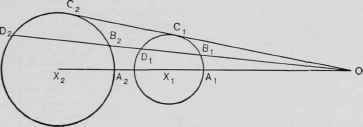
Fig. 66.
The center of inversion is the center of similitude of the original circle and its inverse.
The original circle, its inverse, and the circle of inversion are co-axial.
233. The method of inversion is one of the most important in the range of Geometry. It was discovered jointly by Doctors Stubbs and Ingram, Fellows of Trinity College, Dublin, about 1842. It was employed by Sir William Thomson in giving geometric proof of some of the most difficult propositions in the mathematical theory of electricity.
Section II. - The Parabola
234. A parabola is the curve traced by a point which moves in a plane in such a manner that its distance from a given point is always equal to its distance from a given straight line.
235. Fig. 67 shows how a parabola can be marked on paper. The edge of the square MN is the directrix, O the vertex, and F the focus. Fold through OX and obtain the axis. Divide the upper half of the square into a number of sections by lines parallel to the axis. These lines meet the directrix in a number of points. Fold by laying each of these points on the focus and mark the point where the corresponding horizontal line is cut. The points thus obtained lie on a parabola. The folding gives also the tangent to the curve at the point.
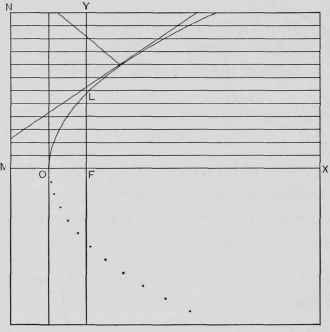
Fig. 67.
236. FL which is at right angles to OX is called the semi-latus rectum.
237. When points on the upper half of the curve have been obtained, corresponding points on the lower half are obtained by doubling the paper on the axis and pricking through them.
238. When the axis and the tangent at the vertex are taken as the axes of co-ordinates, and the vertex as origin, the equation of the parabola becomes y2 = 4ax or PN2 = 4 . OF. ON.
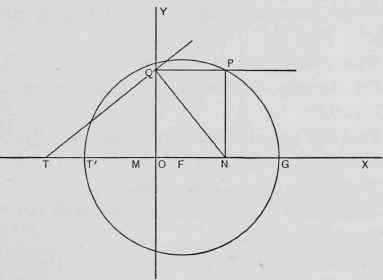
Fig. 68.
The parabola may be defined as the curve traced by a point which moves in one plane in such a manner that the square of its distance from a given straight line varies as its distance from another straight line; or the ordinate is the mean proportional between the abscissa, and the latus rectum which is equal to 4. OF. Hence the following construction.
Continue to:


My Books

