


XIII. The Conic Sections. Part 2
Description
This section is from the book "Geometric Exercises In Paper Folding", by Tandalam Sundara Row . Also available from Amazon: T. Sundara Row's Geometric Exercises in Paper Folding (Large Print Edition).
XIII. The Conic Sections. Part 2
2. And XOB =
XOB = XVB +
XVB + VBO,
VBO,
= 2 XVB.
XVB.
3. ... XVB = ½
 XOB.
XOB.
4. Similarly AVX=½
AVX=½ AOX(each=zero in Fig. 62), and ...
 AVB = ½
 AOB.
AOB.
The proof holds for all three figures, point A having moved to X (Fig. 62), and then through X (Fig. 63).*
209. The angle at the center being constant, the angles subtended by an arc at all points of the circumference are equal.
210. The angle in a semicircle is a right angle.
211. If AB be a diameter of a circle, and DC a chord at right angles to it, then ACBD is a quadrilateral of which AB is an axis of symmetry. The angles BCA and ADB being each a right angle, the remaining two angles DBC and CAD are together equal to a straight angle. If A' and B' be any other points on the arcs DAC and CBD respectively, the
 CAD=
CAD= CA'D and
 DBC=
DBC= DB'C, and
 CA'D +DB'C = a straight angle. Therefore, also,
 B'CA' +
 A'DB' = a straight angle.
Conversely, if a quadrilateral has two of its opposite angles together equal to two right angles, it is inscriptible in a circle.
*The above figures and proof are from Beman and Smith's New Plane and Solid Geometry, p. 129.
212. The angle between the tangent to a circle and a chord which passes through the point of contact is equal to the angle at the circumference standing upon that chord and having its vertex on the side of it opposite to that on which the first angle lies.
Let AC be a tangent to the circle at A and AB a chord. Take O the center of the circle and draw OA, OB. Draw OD perpendicular to AB.
Then BAC=
BAC= AOD = ½
 BOA.
BOA.

Fig. 64.
213. Perpendiculars to diameters at their extremities touch the circle at these extremities. (See Fig.64). The line joining the center and the point of intersection of two tangents bisects the angles between the two tangents and between the two radii. It also bisects the join of the points of contact. The tangents are equal.
This is seen by folding through the center and the point of intersection of the tangents.
Let AC, AB be two tangents and ADEOF the line through the intersection of the tangents A and the center O, cutting the circle in D and F and BC in E.
Then AC ox AB is the geometric mean of AD and AF; AE is the harmonic mean; and AO the arithmetic mean.
AB2=AD.AF. AB2=OA.AE.
... AE = AD.AF / OA = 2AD.AF / AD + AF.
Similarly, if any other chord through A be obtained cutting the circle in P and R and BC in Q, then AQ is the harmonic mean and AC the geometric mean between AP and AR.
214. Fold a right-angled triangle OCB and CA the perpendicular on the hypotenuse. Take D in AB such that OD=OC (Fig. G5).
Then OA.OB=OC2=OD2, and OA : OC=OC: OB, OA : OD=OD: OB.
A circle can be described with O as center and OC or OD as radius.
The points A and B are inverses of each other with reference to the center of inversion 0 and the circle of inversion CDE.
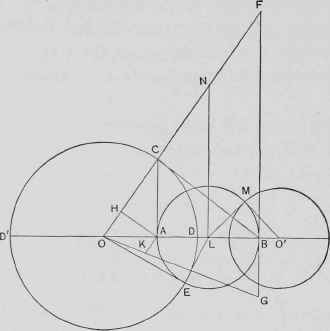
Fig. 65.
Hence when the center is taken as the origin, the foot of the ordinate of a point on a circle has for its inverse the point of intersection of the tangent and the axis taken.
215. Fold FBG perpendicular to OB. Then the line FBG is called the polar of point A with reference to the polar circle CDE and polar center O; and A is called the pole of FBG. Conversely B is the pole of
CA and CA is the polar of B with reference to the same circle.
216. Produce OC to meet FBG in F, and fold AH perpendicular to OC.
Then F and H are inverse points. AH is the polar of F, and the perpendicular at F to OF is the polar of H.
217. The points A, B, F, H, are concyclic.
That is, two points and their inverses are con-cyclic ; and conversely.
Now take another point G on FBG. Draw OG, and fold AK perpendicular to OG. Then K and G are inverse points with reference to the circle CDF.
218. The points F, B, G are collinear, while their polars pass through A.
Hence, the polars of collinear points are concurrent.
219. Points so situated that each lies on the polar of the other are called conjugate points, and lines so related that each passes through the pole of the other are called conjugate lines.
A and F are conjugate points, so are A and B, A and G.
The point of intersection of the polars of two points is the pole of the join of the points.
220. As A moves towards D, B also moves up to it. Finally A and B coincide and FBG is the tangent at B.
Hence the polar of any point on the circle is the tangent at that point.
221. As A moves back to O, B moves forward to infinity. The polar of the center of inversion or the polar center is the line at infinity.
Continue to:


My Books

