


XIII. The Conic Sections
Description
This section is from the book "Geometric Exercises In Paper Folding", by Tandalam Sundara Row . Also available from Amazon: T. Sundara Row's Geometric Exercises in Paper Folding (Large Print Edition).
XIII. The Conic Sections
Section I. - The Circle
181. A piece of paper can be folded in numerous ways through a common point. Points on each of the lines so taken as to be equidistant from the common point will lie on the circumference of a circle, of which the common point is the center. The circle is the locus of points equidistant from a fixed point, the centre.
182. Any number of concentric circles can be drawn. They cannot meet each other.
183. The center may be considered as the limit of concentric circles described round it as center, the radius being indefinitely diminished.
184. Circles with equal radii are congruent and equal.
185. The curvature of a circle is uniform throughout the circumference. A circle can therefore be made to slide along itself by being turned about its center. Any figure connected with the circle may be turned about the center of the circle without changing its relation to the circle.
186. A straight line can cross a circle in only two points.
187. Every diameter is bisected at the center of the circle. It is equal in length to two radii. All diameters, like the radii, are equal.
188. The center of a circle is its center of symmetry, the extremities of any diameter being corresponding points.
189. Every diameter is an axis of symmetry of the circle, and conversely.
190. The propositions of §§ 188, 189 are true for systems of concentric circles.
191. Every diameter divides the circle into two equal halves called semicircles.
192. Two diameters at right angles to each other divide the circle into four equal parts called quadrants.
193. By bisecting the right angles contained by the diameters, then the half right angles, and so on, we obtain 2" equal sectors of the circle. The angle between the radii of each sector is 4 / 2n of a right angle or 2π / 2n = π / 2n-1
194. As shown in the preceding chapters, the right angle can be divided also into 3, 5, 9, 10, 12, 15 and 17 equal parts. And each of the parts thus obtained can be subdivided into 2n equal parts.
195. A circle can be inscribed in a regular polygon, and a circle can also be circumscribed round it. The former circle will touch the sides at their mid-points.
196. Equal arcs subtend equal angles at the center; and conversely. This can be proved by superposition. If a circle be folded upon a diameter, the two semicircles coincide. Every point in one semi-circumference has a corresponding point in the other, below it.
197. Any two radii are the sides of an isosceles triangle, and the chord which joins their extremities is the base of the triangle.
198. A radius which bisects the angle between two radii is perpendicular to the base chord and also bisects it.
199. Given one fixed diameter, any number of pairs of radii may be drawn, the two radii of each set being equally inclined to the diameter on each side of it. The chords joining the extremities of each pair of radii are at right angles to the diameter. The chords are all parallel to one another.
200. The same diameter bisects all the chords as well as arcs standing upon the chords, i. e., the locus of the mid-points of a system of parallel chords is a diameter.
201. The perpendicular bisectors of all chords of a circle pass through the center.
202. Equal chords are equidistant from the center.
203. The extremities of two radii which are equally inclined to a diameter on each side of it, are equidistant from every point in the diameter. Hence, any number of circles can be described passing through the two points. In other words, the locus of the centers of circles passing through two given points is the straight line which bisects at right angles the join of the points.
204. Let CC be a chord perpendicular to the radius OA. Then the angles A OC and AOC are equal. Suppose both move on the circumference towards A with the same velocity, then the chord CC is always parallel to itself and perpendicular to OA. Ultimately the points C, A and C coincide at A, and CAC is perpendicular to OA. A is the last point common to the chord and the circumference. CAC produced becomes ultimately a tangent to the circle.
205. The tangent is perpendicular to the diameter through the point of contact; and conversely.
206. If two chords of a circle are parallel, the arcs joining their extremities towards the same parts are equal. So are the arcs joining the extremities of either chord with the diagonally opposite extremities of the other and passing through the remaining extremities. This is easily seen by folding on the diameter perpendicular to the parallel chords.
207. The two chords and the joins of their extremities towards the same parts form a trapezoid which has an axis of symmetry, viz., the diameter perpendicular to the parallel chords. The diagonals of the trapezoid intersect on the diameter. It is evident by folding that the angles between each of the parallel chords and each diagonal of the trapezoid are equal. Also the angles upon the other equal arcs are equal.
208. The angle subtended at the center of a circle by any arc is double the angle subtended by it at the circumference.
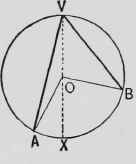
Fig. 61.
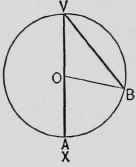
Fig. 62.
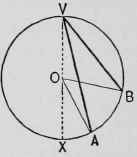
Fig. 63.
An inscribed angle equals half the central angle standing on the same arc.
Given A VB an inscribed angle, and A OB the central angle on the same arc AB. To prove that AVB = ½
 A OB. Proof. 1. Suppose VO drawn through center O, and produced to meet the circumference at X.
Then XVB =
XVB = VBO.
VBO.
Continue to:


My Books

