


The Derrick
Description
This section is from the book "The Scientific American Boy", by A. Russell Bond. Also available from Amazon: The Scientific American Boy.
The Derrick
A derrick was constructed of two sticks 10 feet long, which were bolted together at the top, and secured about five feet apart at the bottom by a cross piece, as shown in Fig. 136. The derrick was then taken apart and with some difficulty hauled piecemeal up to the next ledge above. Here it was put together again. The fall and tackle used in our aerial railway was attached to the apex of the derrick, and the latter was then erected with the legs set into depressions in the ledge and the upper ends slanting outward but kept from falling over the edge by a rope tied to one of the fixed rungs set in the fissure. With this derrick we hoisted up the boards in a few hauls. The job was a very ticklish one, but Bill used the greatest care to prevent accident. The derrick, rope and tackle were carefully tested before used, and as soon as the load was attached to the lower pulley block the two who did the loading were instructed to crawl back into the fissure so as to be out of danger in case anything gave way. At one time a stick which had been carelessly tied did fall, and it might have badly hurt some one had we not observed this precaution. When we had raised the material to the second ledge we transferred operations to the top ledge, and when the materials had been hauled up to this point we finally rigged up our fall and tackle in the old oak tree itself.
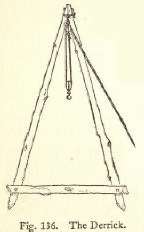
Fig. 136. The Derrick.

Fig. 137. The Derrick in Use.
Continue to:


My Books

