


Introductory. Part 3
Description
This section is from the book "Evolution Of The Machine Shop", by James Hartness. Also available from Amazon: Evolution Of The Machine Shop.
Introductory. Part 3
Working Range
The work shown on this page and on page 86 is the product of the Flat Turret Lathe with the automatic die outfit (outfit I)).
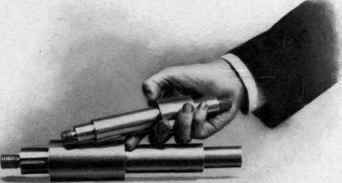
In the 2 x 24 machine this outfit turns all diameters up to 2 1/4 inches, and all lengths up to 24 inches, and cuts all U. S. standard screws from 3/8 to 1 1/4 inches, inclusive, by sixteenths. (Whitworth, Metric or V standard furnished if desired.)
Items of outfits on pages 190 to 193.
The same kind of work is turned out by the 3 x 36 with automatic die outfit, which turns diameters from 3 inches down, and lengths up to 36 inches, and cuts screw threads from 1 to 2 inches, inclusive, U. S. standard. (Whitworth, Metric or V standard furnished if desired.)
Items of outfits on pages 198 to 201.
Special Equipment In addition to the outfit D, the 2-inch die may be furnished for the 2 x 24, and the 3-inch die for the 3 x 36 machine.
The 2 x 24 machine is also made for turning 42 inches in length.


Bar Work. Samples of pieces made from the bar.

Bar Work. Samples of pieces made from the bar.
Multi-Stop And Double Turners
Fig. 1 illustrates the advantage of the double stop for each position of the turret, and the double adjustment of each turner. This piece has six finished diameters and six shoulders, and is turned by only three turners, which occupy only three positions on the turret. This not only leaves the remaining positions free

Fig. 1 for other tools, but it saves the operator the time and energy required to run the turret slide back each time.
All this is obtained without complication, and without introducing any features that are annoying when not in use.
In addition to the double stop for each of the six positions of the turret, we have an extra stop, consisting of a pin which may be dropped into any one of the six holes at the rear of turret slide. This makes it possible to borrow five extra stops for any one of the tools, and gives to this tool seven length or shoulder stops, and leaves one stop for each of the remaining tools.
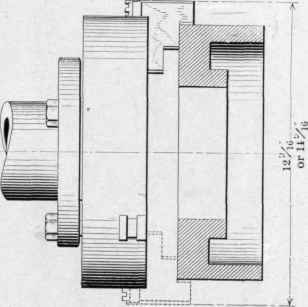
The illustrations, Figs. 2 and 3, give examples of what one tool can do in this machine on chuck work, when we take advantage of the seven length stops and the seven shoulder stops of the cross-feed head.
Of course, in general practice three or four stops for one tool is all that will be needed, but since the modern cutting steels have greater durability, there is nothing lost by giving each tool all the work it can do.
Outer face and all shoulders and diameters may be accurately finished to independent stops by one tool. When roughing and finishing cuts are required, the roughing tool can be set near enough to use the same stops that are accurately set for the finishing tool. When an extra tool is used to give a


Fig. 3. Showing use of Seven of the Twelve Turret Stops by One Tool - also Seven of the Ten Cross-slide Stops


Illustrating Largest Working Dimensions for Both Machines roughing cut it is set as indicated by dotted lines in Figs. 2 and 3.
We find it difficult to illustrate all of the classes of work that can be turned out by this machine, but a little thought will suggest many forms that may be readily handled in bar and chucking work, both steel and cast-iron, on account of the many provisions for bringing both turret and cross slide up to fixed stops, either by power feed or by hand.
Bartlett & CO., N.Y.

Sample of Work Requiring Bar and Chucking Outfit
Illustrating Largest Working Diameter of Both Machines

Front and Back Views of Turret with Tools for Bar Outfit
Continue to:


My Books

