


Constructing A Small Saw Mill
Description
This section is from the book "Cassell's Cyclopaedia Of Mechanics", by Paul N. Hasluck. Also available from Amazon: Cassell's Cyclopaedia Of Mechanics.
Constructing A Small Saw Mill
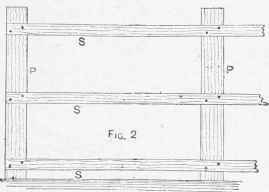
Instructions on building p. shed to be used as a small saw mill are here given. The shed may be constructed of old railway timbers and sheet iron. The dimensions are 55ft. long by 30 It. wide, with a small shed 1(3 ft. by 10ft. at one end for the engine. The holes to receive the posts (P, Fig. 1) should be about 2ft. 6in. deep. To these posts the scantling S (see Fig. 2) is nailed, and to it the sheet iron that forms the sides of the mill, etc., is secured. The tops of the posts should be perfectly level, as the wall-plates must rest on them. The roof principals are secured to the wall-plates, and the rafters are nailed to the principals, the sheet iron that forms the roof being nailed or screwed to the rafters. The engine is fixed at E, and should be of from 10- to 12-horse-power. It will be able to drive a rack saw bench in front of it, and another on the other side of the shed, and m ay be used at other times for running a chaff-cutter, grindstone, and saw sharpener. When the engine has been fixed, the shaft, pulley, and belt ways must be dug of suitable depth, etc., and these openings in the ground should he covered in with timber, a trap-door being placed over each bearing so that free access may be had to the bearings and pulleys. The position of each machine is shown in Fig. 1. From the engine wheel the main belt M leads to a pulley L on the main shaft M s. Belts B lead from the driving pulleys E1 to the driven pulleys on the rack-bench II and the hand-bench IJ. The positions of the sharpening machine and of the grindstone are indicated at S and G. The dotted line outside the building C indicates the position of a shed in which the chaff-cutter may be fixed. The sharpening machine, grindstone, and chaff-cutter may be driven from a small overhead shaft, the end of which passes through the side of the mill into the chaff-house. A pulley is keyed on the end of this shaft, from which a belt leads to the chaff-cutter. Two other pulleys are keyed on this shaft, from which belts lead to the pulleys on the sharpening machine and grindstone. A belt leading from the small pulley F near the end of the main shaft to a pulley on the overhead shaft drives it. A dotted line at the corner shows the position of the grindstone and the sharpening machine. Small posts may be fixed in the ground here and covered with boards or sheet-iron, so as to form a sharpening house, which should be provided with plenty of light. On each side of the mill there should be at least three good-sized windows. Doorways D for each house are shown.
There is a door at ench end of the mill, and in line with the rack-bench, so that a rough log brought in at one door passes out at the other door cut and ready for delivery. This is a great saving of time and labour. The bearings marked A on the main shaft may be secured to blocks of wood or, better still, masonry, firmly fixed in the shaft-way. By laying out the machines in the manner indicated, there will be plenty of room for the timber that is to be sawn, and for the timber already sawn, ana the stuff can be easily passed from the rack-bench to the hand-bench when it is to be sawn into small scantling. Very long timber cannot be conveniently sawn, as the length of the rack is short in such a small mill.

Fig. 1.
Constructing a Small Saw Mill.
Continue to:


My Books

