


How To Make A Portable Photographic Dark Room
Description
This section is from the book "Cassell's Cyclopaedia Of Mechanics", by Paul N. Hasluck. Also available from Amazon: Cassell's Cyclopaedia Of Mechanics.
How To Make A Portable Photographic Dark Room
Here are instructions on making a portable triangular dark room. Make three uprights 6 ft. long of l 1/2-in. stuff, and six cross battens 3ft. 2in. long. The top of the dark room consists of a triangular piece of wood 3 ft. 6 in. by 3ft. 6in. by 3 ft. 6in. Recesses are cut at the corners to receive the uprights, and the cross battens, which give stability, are fastened to the uprights on two sides at suitable places,and in the third side, which forms the door, one batten should be at the top and one at the hottom. The developing table is shown in Fig 1, A being the sink, which is a metal dish sunk in a recess; the dish is fitted with a pipe to carry off drippings to a bucket below. The table should be coated with paraffin wax. B shows a notch to take the upright, and C and D are wing screws that fasten the board to the other uprights. To facilitate packing into the smallest possible compass, wing screws can also be used for the battens. The room must be ventilated by cutting an opening iu the top piece. The opening should be triangular, 1 ft. by 1 ft. by 1 ft., and it should have raised sides like a chimney, 6 in. high. Over this chimney is fitted a cap which is so made as to admit of the free passage of air while excluding light.
The construction of the cap (Fig. 2) is sufficiently explained by the illustration. The frame may be covered with two thicknesses of glazed lining, and a piece of ruby fabric can be let in on one side to form a window. The covering over the door side - which should overlap the whole width to form a light trap - may be hung on rods or suspended from hooks.
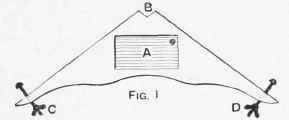
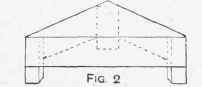
Details of Portable Photographic Dark Room.
Continue to:


My Books

