


How To Make A Shutter For Taking Photographic Doubles
Description
This section is from the book "Cassell's Cyclopaedia Of Mechanics", by Paul N. Hasluck. Also available from Amazon: Cassell's Cyclopaedia Of Mechanics.
How To Make A Shutter For Taking Photographic Doubles
The accompanying sketch shows an arrangement for doubling the same figure on one quarterplate. Construct a framework A in 3-in. wood, having holes B1, B2, B3, B4. Into these fit the rods C, C. The holes should be slightly smaller than the rods, and the latter should be cut down to form a shoulder, thus keeping them in position. Cut two pieces of wire, each equal in length to two sides of the frame, and sharpen the ends. Bend these to the shape shown (D and D1) and fix into the two rods so that the two centres almost touch, thus forming the framework of two doors, made light-tight by covering with thin velvet. These doors should fit exactly, and are, of course, turned by the rods C, C, which project about 3/8 in. beyond the frame. Fit into the inner side of the framework a second frame about 1/2 in. by 1/2 in., against which the doors shut, making a light-tight join. To the projections just mentioned are fastened cog-wheels E and E'. Now take a stout knittiug needle, and wind around it some brown paper, sticking it down with paste to form a paper tube.
Measure half the circumference of the cog-wheel, and cut the needle down flat for this distance, leaving about an inch or so to fit the tube (both may be made from one needle). Notch the flattened part to fit the cog-wheel. The tubes are next fixed through the camera front as shown in section in Fig. 2, and the racks inserted. It will be seen that, if air is forced through the tube, the rack is blown out, carrying the wheel round with it. An extremely thin rubber band F fastened from the inner side of the door to the frame suffices to pull it back. To each of the tubes projecting outside the camera it will be necessary to fit 6 ft. of small tubing, connecting them at the end with a Y-shaped double tap like Fig. 3. By opening one door and keeping the other closed, one-half of the plate may be exposed, the process being l-epeated for the other half. The two images overlap or vignette into each other, so that no join is shown, provided the doors are not too far from the lens. The doors should be at a distance from the lens of about half its focus. If too near, too much of the plate will be exposed. For this reason the exact dimensions cannot be given. The position to be occupied is focussed with one door open and one shut, alternately, the alternate door being closed by turning the tap. The ball for operating the shutter is placed on the floor, to be worked by the foot.
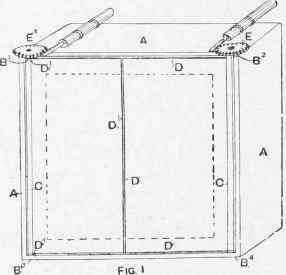
A Shutter for Taking Photographic Doubles.
Continue to:


My Books

