


Pinhole Photography
Description
This section is from the book "Cassell's Cyclopaedia Of Mechanics", by Paul N. Hasluck. Also available from Amazon: Cassell's Cyclopaedia Of Mechanics.
Pinhole Photography
The principles of pinhole photography - or photographing without lenses - arc extremely simple. The discs of light thrown on the ground when the sun's rays filter through intervening foliage are natural examples of pinhole photography, each of these discs being an image of the sun. If a small hole is made in a card and held in front of a lamp, an inverted image of the lamp will lie thrown on any white surface facing the hole. The clearness of this image increases as the size of the hole is diminished anil as the receiving surface is shielded from extraneous light. The brilliancy of the image increases with the enlargement of the hole and with its nearness to the receiving surface. But the definition remains the same. There being no focus, the pinhole camera gives the maximum depth of focus. If two holes are made close together, two overlapping images result; and if a, third hole is placed between the other two, the third image may blur the other two beyond recognition. Pinhole photography, therefore, is only possible with a small hole, and is applicable only to brightly illuminated inanimate objects.
Captain Abney's rule for determining the best diameter of the pinhole is to multiply the sqtiare root of the distance between plate and pinhole by .008. An ordinary camera may be used as a pinhole camera by constructing a close-fitting front with a sliding metal plate containing holes of different diameters. (Jhapmau Jones recommends the following table, which is worked out according to Captain Abney's rule.
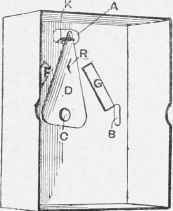
Fig. 1.
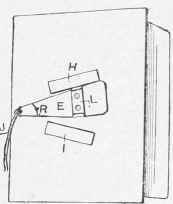
Fig. 2. Pinhole Camera.
Pinhole diameters in iuches | 1/16 | 1/22 | 1/32 | 1/45 | 1/64 |
Distance between plate and hole for sharpest image in inches ......... | 61 | 32 | 16 | 8 | 4 |
The fractions may then take the place of the f ratio in estimating exposure; which, with a subject that would require one second at f/16, will be just as many minutes as the plate is inches from the hole. Or estimate the exposure for the f number and multiply by the square of the distance. Thus, supposing the hole 1/64 in. at 4in.is used and for the subject in hand the exposure for the same plate under the same conditions at f/64 would be ten seconds, then in this case the exposure will be 10 x 42 or 160 seconds. To make a pinhole camera, procure a cardboard box, whose lid and the box itself should each belin. deep; cover the outer sides of the bottom of the box with thin velvet so that the box will be completely enveloped and will be light-tight when the lid is on. Cut in the front of the box three openings A, B, C (Fig. 1) of the size and shape shown. Xow make another box with projecting sides (Fig. 2) to fit inside the first. Cut two pieces of metal as D and E, and rivet to the two boxes as shown at E so that they move freely and independently. Glue ou strips of card F, G, H, and I to form stops, and attach the cords J and K. The piece E has a second piece bent over it, and between these is fixed a piece of tinfoil or extremely thin copper L containing two holes 1/64 in. and 1/32 in. diameter, either of which may be pulled into position when required. The plate is laid face up in the hack of the outer box and is held upright by the inner box when the latter is pushed in. Pull the cord so that the proper hole comes into position in the centre, and close the shutter with the other cord. Stand up facing the view and open the shutter for the required exposure.
Continue to:


My Books

