


Pattern For Compassed Bed Of Under-Carriage
Description
This section is from the book "Cassell's Cyclopaedia Of Mechanics", by Paul N. Hasluck. Also available from Amazon: Cassell's Cyclopaedia Of Mechanics.
Pattern For Compassed Bed Of Under-Carriage
Below is described one way of marking out a pattern for the compassed bed ol an under-carriage. As an example, Fig. 1, which represents an ordinary compassed bottom bed of a brougham under-carriage, is given. To set it out, draw the straight line a (Fig. 1); square off a line B, and from C mark oft the compass 4 1/2 in. to D, which is the centre of the bed. From D, mark off the width of the bed back and front, as E F. At G; and G, which are the spring bearings, on each side of the centre line mark off distances equal to the width of the bed; this is governed by the wheel-iron head. Mark off the size of the wheel plate, as at H H, cutting these points by half the width of the compass of the bed; then, using I on the square line as centre, strike a true line to the points D and IIII. With the same radius, continue the sweep towards the end until it meets the square line, which should be about l in. inside the spring bearing;. With the compasses of the same radius, describe the inner line of the pattern. Fig. 2 shows the elevation of the beds when together, and the method of sweeping them out. The parts K represent the top and bottom bed plates, L the wheel plate, and M the transom plate; the beds are left straight in the centre until the top and bottom plates are fitted, these being screwed on temporarily. The beds must be swept out as shown, care being taken to leave intact the bearings for the wheel plate and transom plate. In testing a carriage for truth, the tools used generally are a straightedge, square board, and wax line. If these do not give a sufficiently exact result, draw a diagram as Fig. 3, setting the squares off perfectly true, when any error can be quickly seen.
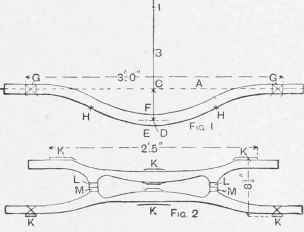
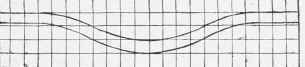
Fig. 3. Setting Out Pattern for Compassed Bed of Under carriage.
Continue to:


My Books

