


Pattern For Conical Rim
Description
This section is from the book "Cassell's Cyclopaedia Of Mechanics", by Paul N. Hasluck. Also available from Amazon: Cassell's Cyclopaedia Of Mechanics.
Pattern For Conical Rim
It is assumed that a copper hoop is to be put round a wooden bucket to ornament it. Below is explained how to draw a plan to which to cut the copper so that it will fit snugly to the shape of the bucket. The pattern wanted is a frustum of a right cone, and to set this out to the correct taper first draw a semi-elevation of the bucket as ABDC (Fig. 1). Next draw the position of the rim F f1 e E, and from E draw a line E f at right angles to E e, and draw F f1. With f1 as centre, and with f1 F and f1 f as radii, draw quarter circles F L and f l to represent a quarter plan of the rim. Divide these quarter circles into an equal number of parts, as F, G, H, f. g. h, etc. Join F f, G g,etc.,and also join F g, (ih, etc., by dotted lines as shown. The lines F f, G g, H h, etc., will be the plans of a series of slants of the cone, and the dotted lines F g, etc., will be the plans of a series of diagonals. F E is the slant of the frustum, and to find the slant of the diagonal draw aline g m at right angles to the dotted line F g, and make g m equal to the line E f. Draw F m, which will be the true slant of the diagonal. To work the pattern, take the length F E and set off on a straight line as F fon the pattern (Fig. 2). Now take the true slant F m (Fig. 1) of the diagonal as radius, and using F (Fig. 2) as centre, draw arcs to cut g g on each side of the centre line. Withfg (Fig. 1) as radius, and f (Fig. 2) as centre, cut the arcs first drawn. Again use the slant F f (Fig. 2) as radius, and with the intersecting ares g g as centres, describe arcs at the top of the pattern (Fig. 2). With F G as radius; and F as centre, cut the arc last drawn. Eepeat this method of working for each division on the plan (Fig. 1), using the small and large divisions and slants and diagonals in their proper order, and make the number of divisions on the complete pattern equal to four times the number on the quarter plan; or if the rim is made in two pieces the divisions would be as shown by the accompanying patterns.
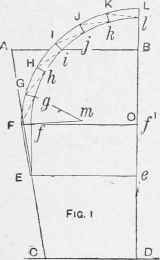
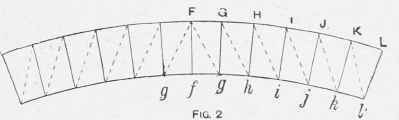
Pattern for Conical Rim.
Continue to:


My Books

