


Portrait Enlargements In Oil
Description
This section is from the book "Cassell's Cyclopaedia Of Mechanics", by Paul N. Hasluck. Also available from Amazon: Cassell's Cyclopaedia Of Mechanics.
Portrait Enlargements In Oil
Painters of cheap oil portraits generally trace the outline with a pantograph or other similar appliance. Better class artists make a bromide enlargement on thin paper, rub the hack with chalk, and trace through with a stylus. Such methods only give rough outlines. Of course, it would be possible to cast a shadow by means of the optical lantern by showing the object by reflected light, but it would be much less trouble to have a quarter-plate negative made. Fix this negative in one end of a box and adjust a lens at the other end at a suitable distance. Block up with brown paper a well-lighted window and place the box, negative side outwards, in an opening cut in the paper. If the canvas is supported on an easel at a proper distance opposite the negative it will receive the enlarged shadow. To obtain a reflected image, make a box A (see diagram) and attach the photograph at B. The lantern with the lens removed is placed at C. The rays are collected by the lens D and projected on to the canvas E. As only a small proportion of the light will be reflected, a powerful light will be needed. Two lanterns would be far better. It might he possible to use two incandescent or duplex paraffin lamps for a slight enlargement.
Any lens of short focus and large diameter could be used.
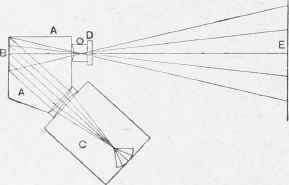
How To Obtain a Reflected Image.
Continue to:


My Books

