


Taking Soundings Of Ship's Well
Description
This section is from the book "Cassell's Cyclopaedia Of Mechanics", by Paul N. Hasluck. Also available from Amazon: Cassell's Cyclopaedia Of Mechanics.
Taking Soundings Of Ship's Well
On each side of a ship's keelson there are "limber holes," which allow the bilge water to pass freely to the lowest part of the compartment, where there is an iron perforated casing to keep out rust chips or other sediment that would prevent correct soundings. These casings are about 15 in. in diameter, and one. is fitted alongside the keelson in each compartment at the lowest point (which is aft in the fore-body compartments and forward in those of the after-body). Any leakage or cargo sweat is free to run down the skin between the frame or ribs to the limbers. The sounding tool is an iron rod 2ft. or 2 ft. 6 in. long, attached to a small line. The ship's carpenter chalks this rod and drops it into the casing or well (keeping it vertical, of course). The well soundings are entered in the log book in inches twice daily. The iron rod is notched with a file at every inch. Some steamers with several compartments have limber holes in some of these which can be immediately closed, in case of collision, etc., by a screw sluice door manipulated from the main deck.
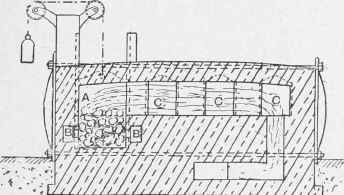
Fig. I.
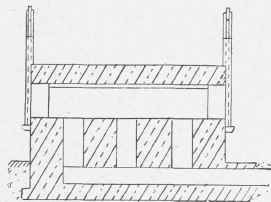
Fig. 2. Furnace for Wagon Springs.
Continue to:


My Books

