


Tools For Dressing Granite
Description
This section is from the book "Cassell's Cyclopaedia Of Mechanics", by Paul N. Hasluck. Also available from Amazon: Cassell's Cyclopaedia Of Mechanics.
Tools For Dressing Granite
Fig. 1 represents the punch that is nsed with the hammer for removing superfluous waste and for pointing the face to almost any degree of fineness. Its cutting edge is sharpened to a stumpy pyramidical point. Fig. 2 shows a hammer-headed chisel used with the hammer for drafts, margins, mouldings, etc. The pitching tool shown at Fig. 3 has a bevelled instead of a cutting edge, and is used with the hammer for pitching and knocking off irregularities or waste lumps on block. Fig. 4 shows a jumper; the tool illustrated is sometimes known as a hand-drill. This is chisel-pointed and slightly round-nosed; it is wider at the cutting edge than the diameter of the tool, so that it clears itself in cutting or drilling circular holes, for which it is vised. Fig. 5 shows a hand hammer (sometimes termed a mash or maul), which is made of steel and varies in weight, though 5 lb. is a good average. It is chiefly used with the punch for removing waste and also for chiselling, jumping, etc. The spaul or spall hammer shown in Fig. 6 varies in weight from 121b. to 161b. It has a square edge of about 1 1/4in., and is a very effective tool for knocking off rough lumps. Fig. 7 shows a pick, about 11 lb. to 16 lb. in weight, which is chiefly used for dressing the inequalities of the rough or rock face, close to the finished surface, or for leaving it with a picked face, and also for scabbling blocks roughly to shape. At Fig. 8 an axe of about 121b. or 111b. weight is shown. It is chisel-pointed for removing the inequalities left by the pick and for dressing the stone similar to tooted work, showing the marks or indents in parallel lines. Fig. 9 shows a patent axe. The body of this is of iron, with a slot at each end, in which a number of thin plates of steel, chisel-sharpened and of equal length, are inserted and tightly bolted together. This tool produces the finest description of face next to polishing. Fig. 10 shows plug and feathers for coping or splitting granite. The plug is conical and of soft mild steel, and the feathers are thin pieces of iron, slightly hollowed and bent to fit the hole. Holes are jumped in the granite about 5 in. or 6 in. deep, the distances apart varying with the tenacity of the material, and the feathers are then inserted. The plugs are driven in and are afterwards tapped with a heavy hammer till all have got a hold; then harder blows are given in quick succession, and the fracture or split made. In the West of England and in the granite districts of America the plugs used in splitting granite are about 5in. long, iin. wide, and | in. thick, and, instead of being conical, taper to about 1/4in. (see Fig. 11), while the steel feathers are about 4 in. long, semicircular in section (see Fig. 12), and tapered upwards to almost a point, as shown in Fig. 13. The feathers are made of mild steel, and are supplied in long lengths by the steel merchants, the rods being a semicircle of 1/2 in. diameter. Steel has superseded iron on account of its durability and greater cheapness in the long run. As has been remarked, sometimes a hand drill is called a jumper, but a jumper proper is shown by Fig. 11; this is in use in all Cornish quarries on account of the speed with which holes for cleaving can be made with it. Thirty holes may be made in half an hour with this tool, though the average is twenty holes per hom\ Three-and-a-half-inch to 4-in. holes are deep enough to cut even the big blocks of Cornish granite used for the docks. The holes are put at an average distance of 4 in. to 4 1/2in. apart, though they can be spread a little if the stone is thin, say up to about lft. 6in. thick. The grain, too, makes a difference, as in cutting the tough way the holes want to be closer together than for cutting with the grain. The jumper is from 5 ft. 6 in. to 6ft. long, and has two bits, one for pitching, say, about Jin., and the other (called the bottomer) for pitching about 1/8 in. less. It is used with both hands.
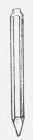
Fig. 1.
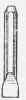
Fig. 2.

Fig. 3.

Fig. 4.
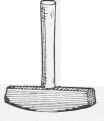
Fig. 5.
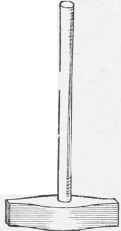
Fig. 6.
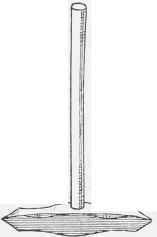
Fig. 7.
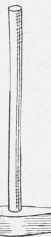
Fig. 8.
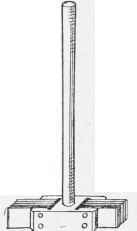
Fig. 9.

Fig. 13.

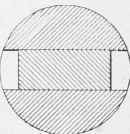
Fig. 12.

Fig. 11.

Fig. 14. Tools for Dressing Granite.
Continue to:


My Books

