


Horology. Part 6
Description
This section is from the book "The Engineer's And Mechanic's Encyclopaedia", by Luke Hebert. Also available from Amazon: Engineer's And Mechanic's Encyclopaedia.
Horology. Part 6
The small screws near the ends of the radii afford an adjustment for time, as the balance will vibrate more quickly the further these are screwed in; and the contrary will be the case if they be unscrewed or drawn further out.
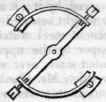
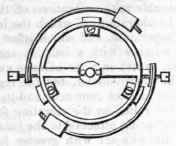
The accompanying cut shows a balance according to the construction of Arnold, and specified by him to the commissioners of longitude. The expansion weights are cylindrical, and are adjusted upon the arms by screwing; and there is an inner rim, upon which three weights are adjusted by sliding, which serve to regulate the going of the time-piece in different positions. The necessity of a different adjustment of the balance, according as the balance is to vibrate with its axis vertical to the horizon, or parallel to it, will be obvious when we consider that the pivots of the axis bear very differently according to the position of the chronometer; and it requires some management to make the frictions the same, whether the axis be turning upon one of its ends, or upon the two cylindrical faces of the pivots; and still more than this, since the balance itself has a permanent figure compared with the spring, which, in every part of its vibration, alters its distance from the axis, and in every part of its length has a different degree of rotatory motion; it cannot be expected, nor does it happen, that a balance, which is found to be in poize along with its spring when out of the chronometer, will make equal vibrations, as to time, in all positions when in its place; and in addition to these difficulties, there is one part of the vibration where the force of the spring and the inertia of the balance are not simply in opposition to each other, but are combined with the maintaining power, viz. during the action of the escape.
The remedy for all these difficulties, which is happily adopted in chronometers for use at sea, is to place the axis in a vertical position, by which means the balance itself is not affected by gravity; but for pocket timepieces, the ingenuity of the artist is called upon for expedients of which it would not be easy to exhibit a complete theory. The general principle commonly used, is to consider the balance, when out of adjustment for position, as a pendulum when above and below the centre of suspension, acted upon by gravity, and, at the same time, urged to a quiescent point by the force of elasticity. In these circumstances the vibrations will be quickest when the point of stable equilibrium is downward, and they will be slowest in the opposite positions of the machine. This leads to the remedy of diminishing either the radius or the weight on that side which is lowest when the rate is most quick. Thus, if one of the two adjusting screws in the first of the preceding balances were downwards in the position of quickest rate, that screw would require to be screwed a very little quantity inwards, and the opposite screw to be screwed a like quantity outwards, in order to remedy this imperfection without much alteration of the other adjustments.
And if a like imperfection were found in the vibrations of the balance when tried in a vertical position, having the lowest point at rest in a line at right angles to a line passing through the radii, a similar alteration must be made in the expansion weights, either by a careful flexure of the circular arcs, or by altering the quantities of those weights; or else by means of small circular screws tapped into the weights themselves, and directed towards the centre like the weights at the extremities of the radii. By these, and other correspondent means, the balance may be made to keep time in all those positions wherein its plane shall be perpendicular to the horizon; but even in these trials Very great pains and labour may be required to produce a high degree of accuracy; and, after all, as the quantity of action in the spring must alter the quantity of pendulous effect in this curious and delicate time measurer, it may be doubted whether the adjustments for position in the vertical balance can be effectual any longer than while the arcs of vibration remain the same.
This consideration points to the necessity of an adjustment in the maintaining power, in order that the vibrations shall not fall off"; the means of effecting this will be shown in treating of the different sorts of escapements, to the consideration of which we shall now proceed.
The escapement is a general term for the manner of communicating the motion of the wheels to the pendulum of clocks or balance of watches. One of the 'most ancient escapements is that which is now applied in almost all common pocket watches: it is represented in Fig. 1, and is best suited to the long vibrations of the balance, which was invented earlier than the pendulum. a b denotes the rim of a contrate wheel, called the crown wheel, having its teeth pointed and sloped on one side only, so that the points advance before any other part of the teeth during the motion, c and d are two pallets or flaps, proceeding downwards from the verge e f. The pallets are nearly at right angles to each other; and when the balance f g, fixed on the verge, is at rest, the pallets remain inclined to the plane of the wheel, in an angle of about forty-five degrees; but when it is made to vibrate, one of the pallets is brought nearer to the perpendicular position, while the other becomes more nearly parallel.
The wheel must be supposed to have one of its teeth resting against a pallet by virtue or the maintaining power.
This tooth will slip off or escape as the pallet rises toward the horizontal position, at which instant a tooth on the opposite side or the wheel will strike against the other pallet which is down. The returning vibration, by raising this last pallet, will suffer that tooth to escape, and another tooth will apply itself to the first-mentioned pallet. By this alternation, the crown wheel will advance the quantity of half a tooth each vibration, and the balance or pendulum will be prevented from coming to rest, because the impulse of the teeth against the pallets will be equal to the resistances from friction, and the reaction of the air. This escapement not being adapted to such vibrations as are performed through arcs of a few degrees only, another construction has been made, which has been in constant use in clocks for this century past, with a long pendulum beating seconds. Fig. 2, on the next page, a b represents a vertical wheel, called the swing wheel, having thirty teeth, c d represents a"pair of pallets connected together, and movable, in conjunction with the pendulum, on the centre of axis f.
Continue to:


My Books

