


Hydraulic Machines. Part 2
Description
This section is from the book "The Engineer's And Mechanic's Encyclopaedia", by Luke Hebert. Also available from Amazon: Engineer's And Mechanic's Encyclopaedia.
Hydraulic Machines. Part 2
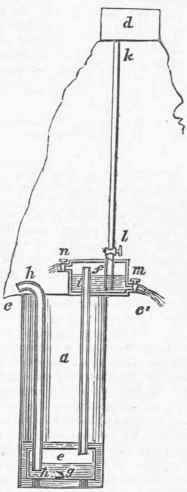
A cock or valve, of large dimensions, is also fixed at m, by which the second chest f can be emptied of its water, and a smaller cock is fixed higher up, as at % for discharging its air. To set the machine in action nothing more is necessary than to shut the cocks l and m, and open the cock n, from which the air previously contained in the lower chest will escape, and its place will be filled up by the water b b, which will pass through the valve g, until the chest e is completely filled. That done, the air cock n is to be shut, and the water cock f opened, when a column of water, equal to the full height and pressure of the cistern d, will rush down the pipe k l, and by filling the chest , will expel its air, which has no other opportunity of escaping but by the open pipe i i, down which it will pass, and produce a pressure on the surface of the water in the lower chest equal to the entire height of the column i l; and the air thus thrown into the chest e, being in a condensed state, will form the water previously in that chest up the pipe h h, from whence it will be discharged at c.
The lower chest e will now be filled with air, while the upper chest f will be occupied by water: therefore the cock l must be shut, and that at m opened, when the whole of the water from f will be discharged at c, and will give the air in e an opportunity of returning again into f through the pipe i i; and as the air from e escapes, its place will be occupied by a new charge of water, which will rise through the valve g, and again fill the lower chest e, and prepare it for a second discharge. All, therefore, that is necessary to keep the machine in action is to open the cocks l and m alternately, that is to say, to keep the cock l open as long as any water flows from the discharging pipe at h c, and as soon as the efflux ceases, to shut the cock l, and open m to discharge the water from f, and permit the lower chest e to fill, which will be effected whenever water ceases to flow from m. The cock m must then be shut, and l opened, and so on alternately, which may easily be done mechanically, and without superintendence, by using a part of the impelling water from d, or that which has been discharged from h c, and which may be employed to turn a small water-wheel, or to fill two small cisterns in which floats are made to act. Mr. John W. Boswell devised a contrivance for answering this same purpose, which will be found fully detailed in the second volume of Dr. Gregory's excellent Treatise on Mechanics, where this simple machine is described under several forms and modifications. It must not be supposed that filling the middle vessel f with water will discharge the whole of the water out of e, otherwise disappointment in its effects will ensue; because, although water is nearly incompressible, air is highly elastic, and the air in e will be compressed into less than its natural bulk, or will be condensed with a force equivalent to the pressure of the perpendicular column of water h h, which it has to overcome; and as atmospheric pressure was shown, when speaking of the pumps under the second head or division, to be only equal to the support of a column of water about 33 feet in height, so if we imagine this to be the height of the pipe h h, that column of water would require one of double atmospheric elasticity to support it, and hence the air in e will be condensed to half its former volume, and, therefore, discharge but half the volume of water, although f should be completely filled. Dr. Gregory further describes a curious phenomenon which takes place in the working of this machine, and which never fails to create surprise in the strangers who visit it, and to whom it is usually shown. That is, when the efflux at h c has stopped, if the cock n be opened, the water and air rush out together with prodigious violence, and the drops of water are changed into hail or lumps of ice, issuing with such force as frequently to pierce a hat if held against them, like pistol bullets. This rapid congelation is a re-markable instance of the general fact, that air, by suddenly expanding, generates cold, its capacity for heat being increased.
The Water Ram, or Belier Hydraulique, as it was called by its inventor, M. Montgolfier, of Paris, is a highly useful and simple machine, for the purpose of raising water without the expenditure of any other force than that which is produced by the momentum or moving force of a part of the water that is to be raised. The effect of this machine depends entirely upon momentum, or the new quantity of force that is generated whenever a body is put into motion; and the effect of this is so great as to give the apparatus the appearance of acting in defiance of the established laws of hydrostatic equilibrium; for a moving column of small height is made to overcome and move another column much higher than itself. The form and construction of the hydraulic ram is shown in the figure on the next page. Suppose o to represent a reservoir, or the source of a spring, which is continually overflowing and running to waste by means of a channel a few feet lower than itself, as at the level line pp. Instead of permitting the water to flow over the sides of o, let it be conducted to the level of p p by means of pipes q q connected with the side of the reservoir, and terminating by an orifice r, in which a conical or other valve s is placed, so as to be capable of effectually closing the pipe when such valve is drawn upwards, t is an adjustable weight, fixed on the spindle of the valve s, by means of which the valve is kept down and open; any water, therefore, that is in the cistern o will
How down the pipe q q, and escape at the orifice r, so long as the valve remains down; but the instant it is raised and shut, all motion of the water is suspended. Thus situated the adjustment of the weight t must take place, and by adding to, or subtracting from it, it must be made just so heavy as to be capable of sinking or forcing its way downwards against the upward pressure of the water, the force of which will depend upon the perpendicular distance from the surface of the water in o, to its point of discharge at r (represented by the dotted line o v); consequently, if the valve s be raised by the hand or otherwise, all motion of the water in the pipe q q will cease, but the instant the valve is released, it will fall down and permit the water to escape. The water by its motion acquires momentum and new force, and consequently is no longer equal to the column o v, to which the valve has been adjusted, but is superior to it, by which it is enabled to overpower the resistance of the weight t, and it carries the valve up with it, and closes the orifice r.
Continue to:


My Books

