


239. Core Prints And Core Boxes
Description
This section is from the book "An Elementary Outline Of Mechanical Processes", by G. W. Danforth. Also available from Amazon: An elementary outline of mechanical processes.
239. Core Prints And Core Boxes
A hollow, recess, or cavity in a casting is usually made by means of a baked-sand core. This core is placed in the mould after the pattern is removed. It occupies the space to be made hollow and is surrounded by metal when the mould is poured.
The pattern is not recessed nor made hollow to correspond with the casting, but, instead, is made as shown in Fig. 108, with solid projections or core prints extending from the part to be hollowed out. The prints in the figure are marked m and n, and when the two parts of the pattern are together, the end view of each print is, in this case, a circle. These prints have the same axis and are of the same diameter as the hollow part of the casting. The impressions which core prints make in the mould serve as bearings to support the ends of the core.
The pattern maker must supply with the pattern a core box, as in Fig. 111, in which the moulder shapes the core. A core box is usually made in symmetrical halves for the purpose of removing a core readily after the sand composing it is properly rammed therein. The halves are placed correctly together by aid of wooden dowel pins and the moulder holds the box together with a clamp.

Fig. 111. - Core Box.
In many cases, cavities or hollows can be moulded without the aid of cores. Patterns are then made, without core prints, to the contour of the desired casting.
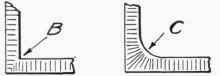
Fig. 112. - Square and Filleted Corners.
Continue to:


My Books

