


377. Marking A Flange
Description
This section is from the book "An Elementary Outline Of Mechanical Processes", by G. W. Danforth. Also available from Amazon: An elementary outline of mechanical processes.
377. Marking A Flange
In boiler making and in sheet-metal work generally, a flange is a margin of metal along the edge of a plate turned at a greater or less angle out of the plane of the plate.
Fig. 226 shows a cross section of a flanged circular plate with the dimensions which would be given by a drawing. The lettering has been added for purposes of explanation. AB is the center line of the drawing, M is a point at the end of the curve of the flange, t is the thickness of the plate, and r is the radius of the inner curvature of the flange. The distance r+t is called the "draw of the flange.
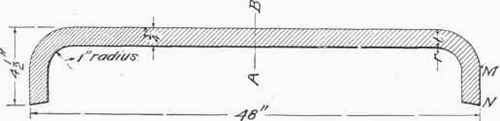
Fig. 226.
The marking of the flat plate, shown in Fig. 227, consists of locating the point M so that it will be 24 inches from the center line AB when the flange is turned. From C as a center describe on the plate a circle with a radius of 24+ r + t / 4 inches. This circle is marked with a series of center-punch marks, as at M', as a guide to the workman in turning the flange, and these punch marks must be turned into the position occupied by M in the upper figure. The plate must have sufficient diameter to allow for the flange width MN of 3 1/2 inches, plus a small amount for chipping to a smoothbeveled caulking-edge. The distance r + t / 4 is arbitrarily added in shop practice to the radius prescribed by the drawing as an allowance for the change of position of the punch marks when the flange is turned.

Fig. 227. - Marking a Plate for Flanging.
Continue to:


My Books

