


8. Classification Of Forces
Description
This section is from the book "An Elementary Outline Of Mechanical Processes", by G. W. Danforth. Also available from Amazon: An elementary outline of mechanical processes.
8. Classification Of Forces
Forces acting upon materials are classified according to their direction of action.
A force acting on a material is called a stress, and the deformation caused by this action is the consequent strain.
If, upon removal of the force, the material returns to its original shape, the strain has been within the elastic limit of the material, but if upon removing the force, the material fails to resume its original shape, it has been strained beyond its elastic limit, and is said to have a permanent set. If the force continues to be increased beyond that causing permanent set, a rupture of the material will finally result.
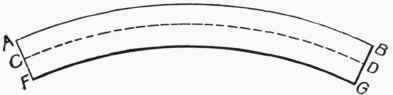
Fig. 1.
Tension is the action of forces tending to pull apart the particles of a material, and tensile strength of a material, expressed in pounds per square inch of cross section of the material pulled, is a measure of the force required to disrupt the material. The amount which a metal stretches in pulling apart is called the elongation. This is expressed as a per cent of the original length of the metal specimen subjected to tension.
Compression is the crushing action of forces.
Torsion is the twisting action of forces.
Shearing is the action of forces tending to cause adjacent parts of a material to move in opposite directions parallel to a plane of cleavage.
To illustrate the result of bending, consider that a piece of material is bent as shown in Fig. 1. Its fibres or particles along AB, and for a distance thereunder, are in tension and are slightly elongated, while fibres or particles along FG, and for a distance above, are in compression, and are slightly shortened.
There is a portion of the piece along CD which is neither under tension nor compression and remains of unchanged length. This is called the neutral axis.
Continue to:


My Books

