


Bent Iron Or Strip Work. Introduction - Tools - Materials - Curves
Description
This section is from the book "Elementary Metal Work", by Charles Godfrey Leland. Also available from Amazon: Elementary Metal Work.
Bent Iron Or Strip Work. Introduction - Tools - Materials - Curves
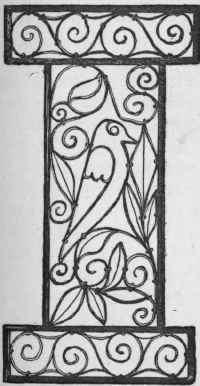
If the pupil or reader would get an idea of the first principles of strip or bent metal-work, let him or her take a strip of cardboard six or eight inches in length, and one third of an inch in breadth. Bend this into a spiral. Then make another of the same size, or smaller, and fasten them back to back by passing a pin through them, and bending the pin flat by means of a pair of flat pincers or pliers. It is evident that this process of making spirals, and attaching them one to the other, can be continued to any extent, and by this alone we can produce an infinite amount of beautiful ornamentation, as will be shown by some of the examples in this book. When the strips of cardboard are attached, and made into some definite shape or object, they can be blackened with paint, and will then resemble iron. It is advisable for pupils, particularly the young, to practise such manufacture in thin cardboard - of playing-card thickness - before beginning with metal, as it rapidly familiarizes the fingers with bending and forming curves, and leads the mind to what is most important of all (yet which is much neglected), that is, the getting a good general idea of what the work in hand is, and fully mastering its requirements and meaning as regards design in the easiest manner. I lay great stress on this, and beg pupils as well as teachers to understand that in metal-work, just as in wood-carving, or leather-work, those will in the end get on the most rapidly, and produce the best results with the greatest ease, who will thoroughly master the first lessons. For it is always easy to do this with a little patience, and then still easier to go on step by step to more advanced work, while, on the other hand, if the hand and fingers are not practised, ready and apt at the rudiments, there will be bungling and trouble for a long time. The difference between a mere amateur and a real artist amounts chiefly to this, that the latter works confidently and boldly, and knows exactly what he wants to do, and is sure that he will do it. Now let the pupil be certain of this, that the very best way by far to become such a bold and ready artist is to learn every lesson from the very beginning very thoroughly, and practise it over and over again. Let him not be in a hurry to produce masterpieces, or rather let him be satisfied to produce masterpieces of rudimentary easy work, which may also be done, for in all arts the most beautiful and even valuable objects are very often among those most easily made.
Continue to:


My Books

