


Copper Jug
Description
This section is from the book "Practical Sheet And Plate Metal Work", by Evan A. Atkins. Also available from Amazon: Practical Sheet And Plate Metal Work.
Copper Jug
The second example is that of a jug, as shown in Fig. 245. The jug is made in four parts - the body, bottom, spout, and handle. The setting out of the patterns is shown in Fig. 246. A half-elevation, showing the spout portion, is first drawn. The line B D is marked in an average position on the outline, and the middle point C determined by drawing the line A C square to, and from the middle of the centre line. B D is made equal to the length of the double curve E F H, the body pattern then being struck out, as in Fig. 244.

The inner circle on the bottom pattern is the same diameter as the jug bottom, and for the outer circle the depth of the foot is added all round.
For the spout the half-section 0 1 2 3 is first marked out, this being divided up, as shown, and perpendiculars dropped on to the line H 3. Then, using centre P, the arcs a b, c d are swept around. The girth line 0' 0' on the pattern is made the same length each side its centre point as the curve 0 to 3 on the spout. Construction lines are drawn through each division point, ana these cut off, above and below the girth line, the same length as the arcs on the spout in elevation. Thus, a' b' = a b, c' d' = c d, and e' f '= e f, the parts, of course, being measured above and below the line H 3. The points obtained are connected up with curves, and so the pattern completed.

Fig. 245.
The hole for the spout will be cut in the body after it has been worked into shape. The handle can be made in the form of a tapered tube, loaded with lead, and bent into shape; or it can be formed out of a bar of solid copper. It may be attached to the body by riveting.

Fig 246.
The seam on the body can be brazed down to form the cone frustum.
After the body and bottom have been tinned on the inside, the latter can be fixed in the former by soldering around the inside.
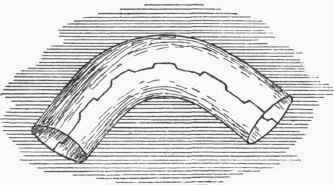
FiG. 247.
The surface of the jug may be polished and lacquered, or treated in any other way as desired.
Continue to:


My Books

