


A Summer Bungalow
Description
This section is from the book "Amateur Work Magazine Vol1". Also available from Amazon: Amateur Work.
A Summer Bungalow
Dr. C. Gilbert Percival in the Brown Book.
It is because a great many persons suffer themselves to live in 6tifling cities throughout the hot weather, who, if they did but know it, could possess an attractive summer home for a mere song, that I am prompted to tell herewith how I recently built a pleasant and enjoyable little affair of a cottage that did not cost me over one hundred dollars.
First of all, select your land. Whether it be by lake, pond, river, bay or shore, or whether you buy or lease it, be sure of three things. These are: that first it is in a healthful district, free from malaria; second, that there is pure drinking water available, and thirdly, that it can be easily reached from your business.
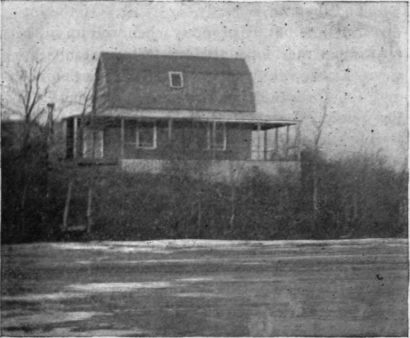
A Summer Bungalow.
After having seen to all three of the above, then proceed to the erection of your house. Select a knoll or elevated spot, and here clear and level away the ground for the foundation of your summer abode. Sills of 4x 5 timber are strong and sufficient. If there are any available stones or rocks, you can use some to put under your sills, but they are hardly necessary unless your site is very sandy I consider a house of 18x14' just about as big as needed, though the size can be varied to suit the individual fancy and requirement.
This summer camp I am about to describe is a fair example of what can be done for less than one hundred dollars. By referring to the ground sketch, it will be seen that the small camp, or shanty, as I call it, is capable of comfortably housing a small family, there being two sleeping rooms. If more beds are required, the couches running around three sides of the camp can be turned into beds at night, they being 80" wide. There are two ample verandas 8' wide and 20' long, each placed so that some portion of it catches the breeze, no matter from which direction it comes.
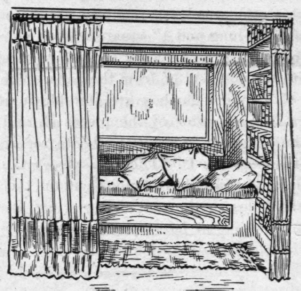
Cosy Corner.
Build your cottage near where your well is to be dug, as the shorter distance you have to carry the water the better. In my own case I have rigged up a trolley arrangement, by which I can run a pail down to the well by its own gravity, fill it and return it to the cottage without much exertion. Water for toilet purposes is furnished from a homemade tank, on the roof of the kitchen. The extermination of insect pests is another important consideration. The cheapest form of exterminator is sulpho-napthol or even pure carbolic acid. When you are applying your heavy roofing paper to sides, floors and roof before shingling or clapboard-ing, you will find if you will paint lightly or brush over with a strong solution of sulpho-napthol, thoroughly saturating the paper, that you will never be bothered with insects. It drives away ants and is sure death to fleas. Before putting down a matting in the cottage, paint the floor with a strong solution of sulpho-napthol or carbolic acid. The odor goes away in a few days, but the death-dealing properties stay in the wood and matting. In the kitchen and on the verandas paint the walls with a hot solution of alum (2 ounces of alum to the pint of water) and you have banished all fears of cockroaches, water bugs, ants and moths.
As can be seen by reference to the floor plan, there is a bay on one corresponding to another bay on the same side, which is used as a kitchen. This kitchen is separate from the rest of the camp by an arrangement of two doors, which is very important in keeping the most generally obnoxious odors of cooking and the heat from the rest of the house. The other bay projects onto the veranda and can be fitted with a broad couch and shelves for books and magazines, as per sketch, and with a portiere or two at night can be converted into a very cosy and comfortable sleeping-room for extra guests.
The kitchen has a large sink, a good cupboard for utensils, and can be entered from the side veranda, which in pleasant weather can be used as a dining-room, it being far more preferable to eat out of doors on the. cool veranda in hot summer weather; and for this purpose I have provided my house with a table 7' long, which, when not in use, is hinged so as to fall flat against the side of the house out of harm's way, and giving free use of the veranda for hammocks and easy-chairs.
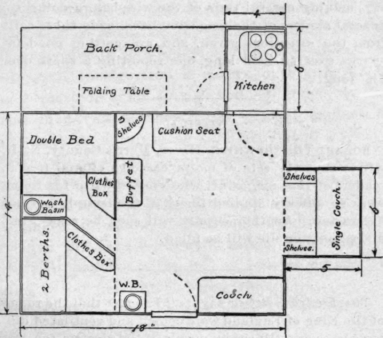
Plan of Bungalow.
To those who contemplate building a summer residence similar to the one described in this article, the following statistics as to cost and materials may not be amiss:
Materials And Cost
Material | Quantity | Cost |
Hemlock boards Pine boards Framing lumber Flooring lumber Shingles Laths • Canvas Paper Nails Hardware Paint Windows Sinks Incidentals Carpenter's wages | 1,000 ft. 400 ft. 500 sq. ft. 400 ft. 4,000 1,000 30 yds. 2 rolls 25 lbs. 5 3 1 week. | $18.00 9.00 10 00 8.00 10.00 1.00 3.00 5.00 2.00 2.00 2.00 5.00 3.00 6.00 16.00 |
Total | $100.00 |
As can be seen by the plan, every inch of the available room is taken advantage of, and some very unique bedrooms are the result. The principal bedroom is 6' 6" in width and 11' long. In this, without crowding, is placed a 4' bed, a washbowl with running water drawn from a rain cistern on the roof, a clothes-closet 6' long by 21/2' wide, and another one over 2' long by 2 wide. This room has one window opening over the washbowl, and is really the most comfortable room in the house. The next room adjoining is for the children, and is 61/2' square and contains two beds, each 30" wide, arranged one over the other, like a steamship stateroom.
The partitions between the general rooms and the sleeping-rooms are made of light canvas nailed over laths.
For boarding I prefer hemlock, because it is cheap and easily handled. These should be covered with heavy building paper, which is both wind and mosquito proof, and then clapboarded. The roof can be done with the same, the paper being given a coat of paint before shingling. I have shingled my entire cottage, treating each shingle with creosote stain and the whole a coat of moss-green stain. For my floor I use first a floor of hemlock, then a covering of heavy building paper, and then a floor of hard pine laid the other way across.
Continue to:


My Books

