


Correspondence
Description
This section is from the book "Amateur Work Magazine Vol1". Also available from Amazon: Amateur Work.
Correspondence
Our readers are invited to contribute to this department, but no responsibility is assumed for the opinions expressed in these communications.
Letters for this department should be addressed to Editor of Amateur Work, 85 Water Street, Boston.
They should be plainly written on only one side of the paper, with a top margin of one inch and side margins of one-half inch.
The name and address of the writer must be given, but will not be used, if so requested.
Enclose stamps, if direct answer is desired.
In referring to other letters, give the number of the letter referred to, and the date published.
Illustrate the subject when possible by a drawing or photograph with dimensions.
Readers who desire to purchase articles not advertised in our columns will be furnished the addresses of dealers or manufacturers, if stamp is enclosed with request.
To Divide a Circle into Any Number of Equal Parts.
Roxbury, Mass., Dec. 10, 1901. To the Editor:
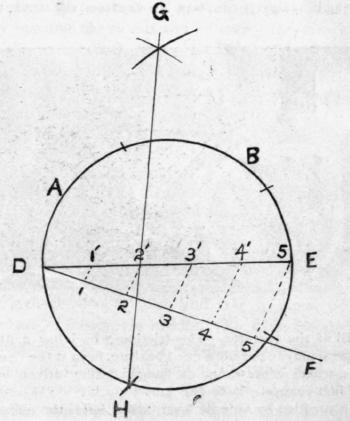
I am greatly interested in the lessons on " Mechanical Drawing" and accept your invitation to write of any matters of interest, and so present another method of inscribing a polygon of any number of sides, or, as it is sometimes stated, "to divide a circle into any number of parts." I prefer this method, as I think it quicker and easier. The enclosed sketch will illustrate how it is done. The circle A B C is to be divided into five equal parts. The diameter D E is divided into five equal parts, as given by Mr. Childs. Then with D and E as centers, and D E as radius, describe two arcs intersecting each other at G. From the intersection at G draw the line G 2', which is continued to the circumference at H. The arc D H is one-fifth of the circle. With the dividers step off the remaining parts. Care must be observed by either method to insure accurate results. Y.
Continue to:


My Books

