


Hammock Making. II. Canvas Hammocks
Description
This section is from the book "Amateur Work Magazine Vol1". Also available from Amazon: Amateur Work.
Hammock Making. II. Canvas Hammocks
E. H. Perkins.
Hammocks made from this material are by many people considered the most satisfactory. A stout piece of denim may also be used if a colored hammock is desired. They may be made with or without a stretcher, but when one is used it is placed inside the hem at each end and sewed in. A curved is better than a straight stretcher.
To make a comfortable hammock a stout piece of canvas 6' long and 3' wide is necessary. If the material is not wide enough, make a seam in the center by overlapping the two selvages 1/2", and stitch each edge flat to the cloth. The sides and ends are hemmed. A small rope or cod line placed inside the hem on each side gives additional strength. The hems at the ends are 3" wide, and in the middle of each are placed the eyelet-holes, which are made for the leaders, or clews, as they are called on navy hammocks. There are twenty-four eyelet-holes on each end, at equal distances apart. A small ring, made of closely woven cord urement. The front and back pieces are rabbeted on the ends for the side pieces, and on the lower edges for the bottom pieces, and are well glued and put together with wire nails. With the necessary hinges and catches in place, the cabinet is now complete, with the exception of staining or other finish, which is left to the fancy of the maker. While there is considerable work in making such a cabinet, it is not at all difficult, if proper care is used. It is one of the most useful pieces of furniture that can be added to the household, and only requires to be used to be thoroughly appreciated.
about 1/8" in diameter, is placed in each eyelet-hole and thickly sewn over all the way around with twine. The leaders may be made of cod line or any stout line, and should be about 3' long. Two rings similar to those used in the netted hammocks are needed.
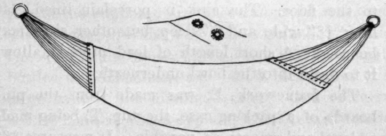
To make the leaders pass the line through the first eyelet-hole, making a stout knot at the end, which must be on the under side of the hammock. Pass the leader through the iron ring, which should be placed 3' from the eyelet-hole, and make a tight knot at the ring. Carry the line to the second eyelet-hole and cut off the line, leaving enough to make a stout knot, which, like the first, must be on the under side of the hammock. Pass the line through the third eyelet-hole, making a knot on the under side, then through the iron ring with a tight knot and into the fourth eyelet-hole, cutting and knotting as in the second eyelet-hole. Continue until all the eyelet-holes are filled, and the hammock is done.
Hammock Making. III. Barrel Hammocks.
A barrel hammock has the advantage that rain does not harm it, and there is therefore no necessity to take it in every night, as with most hammocks. Sugar barrels are the best to use, but almost any barrel will answer. Two barrels are needed, as twenty-four or twenty-five staves are used in an ordinary-sized hammock.
Break the barrels apart carefully, and after removing all the nails, smooth the edges of each stave with a draw knife or plane. This done, bore a hole 5/8" in diameter 21/2" from each end of the staves.

For supporting the staves, 80' of quarter-inch rope or strong clothesline will be required. This rope is divided into four lengths of 20' each. Taking two of these pieces, tie them together with a strong knot 4' from the ends. Pass the loose ends through the hole in the end of one of the staves, one through the upper side and the
Continue to:


My Books

