


How To Make A Tent
Description
This section is from the book "Amateur Work Magazine Vol1". Also available from Amazon: Amateur Work.
How To Make A Tent
T. C. Prentiss.
A tent suitable for a small camping party or for children to play in can easily be made by any one who can run a sewing-machine. The shape here described is known as an A, or wedge, tent, 9 to 91/2' long, V wide, and the pole 71/2' high. The dimensions will vary a little, due to the variation in the width of duck or drilling, either of which may be used, though duck is more serviceable and will shed rain better than drilling. The material used depends largely upon the service required. For ordinary shelter, drilling will answer nicely and is less expensive than duck. For a tent of the size above mentioned 31 yards of cloth 30" wide are required. First cut four pieces 17' long and sew them together with a lap seam 1/2" wide, stitching each seam twice ; that is, lay the edge of one piece of cloth upon the edge of a second piece, so that the edges overlap for 1/2", and run the stitching 1/8" from the edges of the cloth. Use heavy linen thread and a heavy machine needle, taking care to see that the overlays are in a uniform direction.
When the four strips are sewed together make the end pieces, the front one differing slightly from the rear one on account of the opening. For the rear end cut a piece 10' 1" long. Mark a point on one side of the piece 2' 5" from the end, and on the other side 7' 71/2" from the end, and with a pencil draw a straight line between these points. Cut the cloth along this line. Put the long edges of the two pieces thus obtained together and sew with a 1/2" lap-seam, as previously mentioned. Cut another piece of the cloth 2' 5" long and 14" wide, and then cut this piece diagonally across to make triangular pieces, which should be sewed, one on each side of the two pieces previously mentioned, with a \" lap-seam. These four pieces form the back and are sewed to the sides with a 1/2" lap-seam, the edges of the back being turned under the sides. All seams should be double stitched. The front is made in nearly the same way as the back, with the exception that the center seam is sewed last, and then only runs V 7" at the top, the remaining 6' being open. A strip of the cloth, 6' 2" long and 6" wide, is hemmed on the right edge and at the top with a 1" hem, and then sewed with a lap-seam to the center edge of the left strip, and at the top forming a fly opening. The front is then sewed to the sides with a 1/2" lap-seam, the edges of the front being turned under the sides.
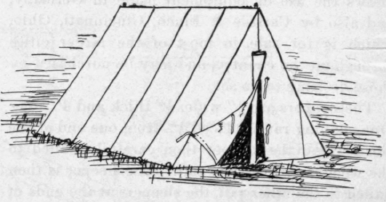
The bottom of the tent is then trimmed evenly, and a 1" hem made around it. Through this hem, at each seam, cut small, round holes, and overcast the edges firmly with cotton twine. Similar holes are made in the top, 1" from each end, through which project the iron rods in the upright tent poles. Pieces of clothesline about 15" long are put through these holes and firmly knotted on the inside. These are used to tie to the tent pegs, to hold the tent upright. From waste pieces of the cloth make six strips 1" wide and 12" long, double thickness, and stitched along the edges, and fasten same, three on each side, to the inside of the opening. These are used for tying on the inside at night.
The poles may be made of 2" round oak curtain rods, or if these are not obtainable, spruce poles may be shaped with a draw-knife and plane from stock 2" square obtained from a lumber dealer. In the latter case it is not necessary to make them round, octagonal will answer ; in fact, military tent poles are often of this shape. The upright poles should be nearly 8' long, the length of the cross-pole being obtained by carefully measuring the length of the tent. Tent-pole irons can be obtained from any large hardware dealer, who will order them if he has not them in stock. It would be well to order them along with the rest of the materials, to avoid possible delay. The irons needed are two iron rings for the cross-pole, with holes for the iron rods; two iron rings without holes, and two short iron rods for the upright poles. The iron rods are sunk for about one-half their length in holes bored in the upper ends of the uprights, and then the rings are snugly fitted on. The rings with holes are likewise fitted to the cross-pole, and holes bored through the pole to receive the iron rods. Be sure these holes are both bored through in the same line. By putting a small stick in one hole to indicate its direction, the other hole can easily be bored to match it.
To erect the tent, fasten one side to pegs in the ground, join the poles together, and put them flat inside the tent. Lift the poles and tent to an upright position, and holding the tent, pull out the other side to the proper place and attach to pegs previously driven in the ground.
Continue to:


My Books

