


A Chamber Set. III. Chiffonier for Men
Description
This section is from the book "Amateur Work Magazine Vol3". Also available from Amazon: Amateur Work.
A Chamber Set. III. Chiffonier for Men
JOHN F. ADAMS
A chiffonier, designed especially for gentlemen's use, is at present a novelty in the furniture line, but is rapidly becoming very popular, as it allows the wardrobe to be much more conveniently stored than can be done in a bureau or or chiffonier of the usual style. The one here described can easily be made by any one familiar with the use of wood working tools.
The four corner posts are 1 1/2 in. square and 47 in. long. Rabbets 1/4 in. deep are cut for the end pieces, which are 41 1/2 in. long, 21 in. wide and £ in. thick. Because of the width the end pieces as well as the top will have to be glued up, care being used to get a good match with the grain along the joint. The top is 40 in. long, 24 in. wide and $ in. thick. A frame is also made of strips of birch 3 in. wide, which will measure outside, 37 in. long and 22f in. wide. The corners are cut out to fit around the posts; this frame fitting under the top and serving to give stiffness to the frame. The back edge is set in 1/2 in. from the back of the top, the sheathing of the back being nailed thereto. A similar frame is made and put in under the two drawers at the top, and a piece of board £ in. thick placed between the two frames, dividing the drawers. A similar frame is also made to go under the lower drawers.
Two narrow cross pieces go across the front, that under the top being 1 1/2 in. wide and that at the bottom 2 in. wide; both are 28 in. long, thus giving 1 in. on each end for tenons to fit mortises cut in the posts. The frames, top ends and cross pieces being cut out and fitted, they are assembled and fastened firmly with glue and screws; the back is then sheathed with 1/2 in. matched sheathing.
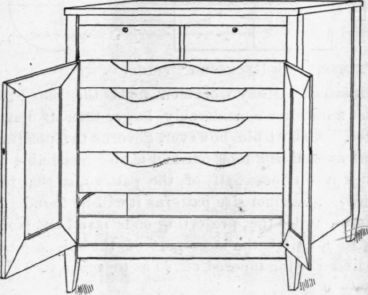
The two top drawers are 17 1/2 in. wide, 22 3/4 in. long, and 5 1/4 in. deep ; the fronts are 6 in. deep, projecting 3/4 in. below the bottom of the drawers, thus concealing the frame upon which they rest. The inner edge of this lower part is also cut away for about 4 in. in the centre to make a place for the fingers, with which to pull them open. The fronts are flush with the cross piece above.
Two panel doors are then made to fit in the front, which are 31 1/2in. high and 18 in. wide. The frames are made of 7/8 in. stock 3 in. wide, the mortises for the corner joints being mitred. Rabbets 3/8 in. wide and deep are cut on the inner edges for the panels, which are 26 1/4 in. long and 12 3/4 in. wide. All joints should be strongly glued and set up with clamps while drying.
The remaining drawers are all 36 in. long and 22 in. wide, other dimensions being : the two top ones 5 in. deep ; the next 6 in. deep, the next 7 in. deep, and the bottom one 9 in. deep, the front board of the latter being only 5 in. wide. The runs for these drawers are made from strips 1/2 in. square, which are attached to either solid boards or frames placed on the insides between the posts and flat against the inside of the ends. To allow room for the runs, the sides and back of all the drawers except the top are 5/8 in. less in depth than are the front pieces. The front pieces are cut out to the curves shown, so that the contents of each drawer can be seen. The edges of these curved parts are rounded and carefully sandpapered.
The doors are hung with three brass hinges on each, a bolt fastening is put on the bottom of the left one and a lock on the right one. Locks are also put on the two upper drawers. Nothing has been said about the kind of wood used, this being left to the choice of the maker as well as the finish. In mahogany it makes a fine looking piece of furniture, this being the wood used for making the one from which this description is taken.
Continue to:


My Books

