


A Mechanic's Note-Book
Description
This section is from the book "Amateur Work Magazine Vol3". Also available from Amazon: Amateur Work.
A Mechanic's Note-Book
" Amateur. "
In almost anyone's daily reading and experience he •comes across many notes and sketches which are worth saving for future reference. These are apt to be taken down on loose sheets of paper, and lost before being needed again. A description of a simple note book and some methods of arranging material so that it will be easily found when wanted, is here given.
Of course, any kind of note book can be used and information, tables, etc., put in as fast as found, but in this way it will be difficult to find any desired article without going through the whole mass. It is therefore desirable to have some kind of loose-leaf, or expansive book, which will allow of any desired arrangement. There are several kinds on the market, but the good ones are rather expensive, and those with a flat binder put through and bent over, are objectionable from the fact that when the book is separated it is necessary to remove the binders, leaving the sheets loose, which is not only troublesome, but after a time the holes in the sheet become so worn that they are useless. The following is the description of a note book made by the writer, which allows easy separation for insertion rearrangement, and is nearly as easy to write in as a bound book.
At almost any stationary stores "Students' note book covers " can be obtained; these are board covers like Fig. 2, with a hinge and a narrow strip along one edge with eyelets to take binders, which are bent over with the paper between. They come in several sizes, and a pair should be obtained of the size desired for the note book, say, 6" x 8" or 8" x 10", the latter being a handy size as it is large enough to accommodate quite a large table or sketch. If these are not obtainable, the cover can be made of an old book cover or a piece of pasteboard covered with cambric pasted on. The narrow part is about |" wide and there is about 1/3" left between the two for the hinge, the covering being pressed down between them to keep them apart. The inside is then lined with paper.
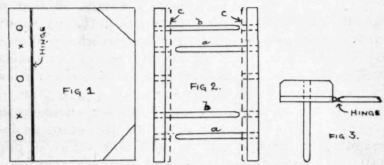
If the cover is purchased, there will be a hole near each end, and perhaps in the middle of the narrow part, two more holes about 1/8" diameter should be punched about 3/4" from those already there, as shown by the crosses. Two pieces of hard wood about 1/4" thick, and the same length and width as the end pieces are procured, and also four pieces of brass rod, 1/8" diameter and about 1/2" longer than the desired thickness of the book. These should have the ends smoothly rounded, and are to be fastened into the wood strips as shown in Fig. 2. A good way to do this is to thread the end and screw it into the wood, or it may be carefully driven in and held by friction, or a brass screw.
The hole opposite each pin should be a loose fit to allow the pin to pass in when there are few leaves in the book. The covers are slipped on as shown by the dotted lines c, c, and the cover is ready for use. The middle hole is to pass a cord through to hold the book together. The best paper for this use is a thin bond, as it bends easier and is thin enough to lay on a drawing and trace through, if desired. It can be obtained at a stationers for from 50 cents to $1. 50 per ream of 500 sheets and can easily be trimmed to suit, but the best way will be to buy a ream and make the book to suit. The sheets are all to be punched with the five holes, and care must be taken to have all punched as near alike as possible, so that the edge of the book will be fairly even. They can be then slipped on to the pins and the book is complete. It will be seen now, that if it is desired to separate the book at any point to insert or remove a leaf, a part will stay on the pins b b, and the rest on pins a a, and it is readily put together again, and held by a cord passed through the middle hole.
The best way of keeping the material that the writer has been able to find is to divide the book into several different divisions or heads, such as, workshop receipts, useful formulas, references to articles, etc., personal needs governing the number and kind of classification. Each article as it is put into the book is filed alphabetically in its proper head. As the size of each division increases it will be found helpful to have the leaves tabbed with the letters of the alphabet. These may be made of card about \" wide and pasted on the leaf with the letter extending out from the body of the book, thus allowing easy access to any letter. If desired, these alphabets may be purchased of 1« ather all gummed, ready to stick in place, and are much more durable than plain paper ones.
Short formulas, etc., can be copied in directly and preserved intact, clippings may be pasted in, but should be pasted along the inner edge only, to allow the book to open smoothly. Any article which is too long to be copied and cannot be cut out may have its location noted; the publication, date and page; so that it will be easily found. Sketches or diagrams can be drawn out and inked if desired; this is a very good idea, as blue prints can be taken through the thin paper if a copy is desired. As fast as notes are taken the book is taken apart and the page inserted in its proper alphabetical position under its right head.
In the writer's experience of compiling data, references, etc. this method is the one which has been of the greatest use to him, and it is hoped that it wilt also prove useful to at least some of the readers of Amateur Work.
Continue to:


My Books

