


Elementary Mechanics. I. The Lever
Description
This section is from the book "Amateur Work Magazine Vol3". Also available from Amazon: Amateur Work.
Elementary Mechanics. I. The Lever
Prof. J. A. COOLIDGE, English High School, Cambridge, Mass.
How can a teamster with a long stick of timber lift one corner of his heavily loaded wagon, so that a wheel can be taken off? How can a freight agent with an iron bar move a freight car weighing 20 tons by simply putting his bar behind one of the wheels and using a very moderate amount of force? How can a carpenter with a hammer pull a nail from a board? These and many other similar questions in mechanics, arising in our daily life, are before us demanding an answer, and we will now set about our task, making our own simple and inexpensive apparatus, that shall, however, give us accurate results. The first principle to receive our consideration is: The Lever.
For our levers, we need two pieces of wood (maple, or some other hard wood is better) 40" long, 2" wide, aud 1" thick. These must be carefully and evenly planed and sandpapered, so that they will balance on a pivot placed under the centre of the board. They should be marked off accuractely in inches and half inches, and then given a coat of shellac. We will now make two pivot blocks on which our levers shall turn. They should be triangular in section, 4" long and 2" wide. A block, or box filled with sand, 4" square, and two pieces of wood 2" x 3" x 5" will complete our wood work.
We suppose everybody has access to a carpenter's bench and tools, for if one does not have them himself, he will find almost any carpenter, if approached wisely, sufficiently interested in his project to be willing to allow the use of his bench and tools and also to give valuable advice. We shall need a set of weights to use in these experiments and the others that will follow. To make these, two ways are suggested. Take an ordinary screw eye or screw hook, twist about it a short piece of wire, insert this in a quarter pound baking powder box (or a smaller one if you can get one) and pour in some melted lead. See Fig. 1. By filling our can to different depths we can get a number of weights of different sizes. These we will take to some store where we can cut or file off enough until they are of exactly the required weight. Any grocer will give the use of his scales for this purpose. We will make a se consisting of one 4 oz. one
8 oz. two 16 oz. two 32 oz. one 48 oz. and one 64 oz., and a convenient box ready for use and storage. The screw hooks can be bought for five cents a dozen. The lead will melt in any iron pan on a kitchen stove. Moulds can also be made by placing two pieces of smoothly planed hard wood of fine grain, boring holes of different sizes centreing on the joint, and held together by a large screw or clamp at each end. After boring the holes, smooth the surface with graphite powder. The screw eyes are held in position while poring, by putting the screw through thin pieces of wood, and placed across the centre of the hole. A cheaper set of weights may be made by sewing up some little bags of cloth and filling them with sand so coarse that it will no1 sift through. Our apparatus may be seen when adjusted, Fig. 2. Let us call the weight at the right, the power, F, the fulcrum oi pivot, W, the weight to be lifted, B, the box that raises the lever above the table on which it rests so that the weights P and W may be suspended from the bar by loops ol wire or twine, B and B two blocks placed under the ends of the lever to prevent it from turning too far. The distance along the bar from F to P is the power arm and from F to W is the weight arm
Experiment I. Support the bar at its centre on F. a. Hang a 16 oz. weight 10" to the left oi F. See if a 16 oz. power 10" to right of F will balance.
6. Hang a 32 oz. weight 5" to the left of F, See if a 16 oz. power 10" to right of F will balance.
c. Hang a 64 oz. weight 6" to the left of F, See if a 32 oz. power 10" to right of F will balance.
d. Hang a 20 oz. weigh 4" to the left of F. See if a 4 oz. power 20" to right of F will balance.
Try two more cases using other weights and distances. Notice that in cases b c, d, a small power at a long distance will balance a large weight at a short distance. Also that the power P x the power arm P F equals the wt. Wx the wt. arm W F. This is the law of the lever, discovered by Archimedes, 250 B. C. We have now an explanation of the teamster lifting his wagon. A man weighing 160 lbs, using his weight as
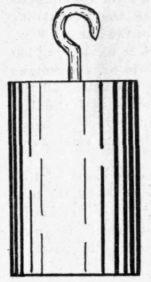
Fig. 1
a force on the end of a timber 12 ft. long, if the fulcrum is 10 ft. from the end, exerts a turning force of 10 x 160, or 1600. If the wagon rests on the end of the lever 2 ft. from the fulcrum, the weight of the wagon x 2 equals 1600. Therefore the wagon must weigh 800 lbs. With a longer bar and a shorter weight arm, he can lift more.
In all the trials just made, we have rested the bar at its centre. Now we will place the pivot nearer one end and see if the weight of the bar has any effect. Before doing this, let us weigh carefully one of our levers at some store and on the bar mark its weight in ounces.
Experiment II.
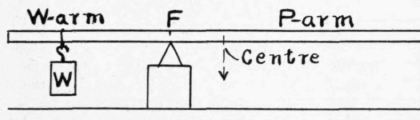
Let us hang a 32 oz. weight, 5" from the left end of lever, with the fulcrum 5" further to the right. Our bar will balance, perhaps, without any power, i. e., there is so much more of the bar on the right of the ful-crum that a weight of 32 oz. is needed on the left, to have the lever balance. See Fig. III.
According to the law of the lever, Px P A equals W x W A ; but the only power used is the weight of the lever, therefore, P x P A equals 32 x 5. As P is the
Fig. 2
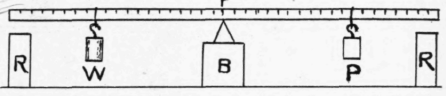
Fig. 3
weight of the lever, its distance should be 10 inches if the lever weighs 1 pound, or less if the lever weighs more than a pound. If the distance is 10 inches we find the place where it acts is at the centre of the lever. If this is so the weight of a lever plays a part in its use, althongh, unless it is very heavy, a comparatively small part. To test the accuracy of this experiment, let us take the lever that we have not weighed, and arrange it as in Fig. HI. When we have made it, lower arm, weight arm, and weight, balance, we have (P arm Wt A arm, and Wt). As P x P equals W x. W A, we can find P by solving this equation, or dividing W x W A by P A.. But as P is the weight of the lever, we have found its weigbt. Now we will weigh this lever, and we should find our esults correct within one or two ounces. Experiment III.
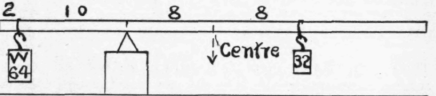
To test the accuracy of our conclusions place our pivot 12 inches from the left end of the lever. See Fig. IV. Hang a 64 oz. weight 10 inches from the pivot and see what force, 16 inches to the right, will balance this weight. Our power now consists of two parts, one the weight of the bar which acts at the centre, and the other, the smaller weight hung 16 inches to the right of the pivot. Our calculation will be; Wt x W A arm = wt. of lever x distance of F to centre + P x P arm.
If our bar weighs 16 oz. these should be 64 x 10 = (16 x 8) + 32 x 16 = 640 = 128 + 512
Fig. 5

In the experiments just performed, the power is always at, or near one end, the weight is at the other end and the fulcrum or pivot between. The power acts vertically downward. Levers of this kind are called levers of class I. We must now consider class II. where the fulcrum is at the end of the lever, and the power is exerted upward. For experiments of this kind, a spring balance, measuring from 1 to 64 oz. is very desirable, as the balance can measure a force exerted vertically upward. We will, however, arrange two levers so that on one of them the force will be exerted upward with an amount that can be measured. Experiment IV.
The lever 1 rests on a box X, whose top and bottom have been removed so that lever 2 can pass through the opening and rest with one end on B. Our only need of lever 1 is to change a downward force at P into an upward force at S. In this way the pull on the string S raises the right end of lever 2 and with it the weight W. To simplify matters let P be hung at the middle of bar 1, and W at the middle of bar 2. We find then in lever 1, that the total force is P + the weight of bar 1, which we will make equal to 36 oz.
As this is to be 10 inches from the pivot, P x P A = 36 X 10 = 360. Then in lever 1 W x W A = 360, but we have made W A = 5 inches; therefore, W =
360 ÷ 5 = 72. In lever 1 the weight is the pull exerted on the string S and is not really a weight lifted, but become sthe force in lever 2. This force, then, in lever 2 is 72 oz. As S is 30 in. from Pin lever 2,PxPi = 72x30= 2160. W in lever 2 is equal to the weight of the bar together with the weight W, which we will hang at the centre of the bar 2. W x W A must equal 2160, and as W A = 10, W, = 2160 ÷ 10 or 216 oz. If one bar 2 weighs 16 oz. the weight W should be 200 oz. and we must use about all the weights we have made. The questions of the bar moving a freight car, and the hammer drawing a nail cease to be incredible when we see this small force overcoming so large a resistance.
We ought to try two or three more cases of this kind, but with the directions already given, the task is an easy one. Usually in class 1, always in class II, the power is small and the weight large. There remains a kind of lever, class III, in which the power is always larger than the weight. The arrangement of a lever of this class is much like that in class II; the pivot is at the end but must hold that end down as the tendency of that end is to fly up. the power is near the pivot and the weight at the other end. Experiment V.
Arrange lever 2 as in Fig. 5, only tie the bar down at F by means of a string run through a hole bored in block B. Some weights must be placed on B to keep it down. S and W in Fig. 5 must change places. The calculations will be the same as in case II, only the power arm is short and the weight arm long. Make S 64 oz. and the distance from F 10 inches; if W is 32 inches from F its value must be 20 oz. Make one or two additional trials using your own values. A fishing pole is, perhaps the simplest implement that is a lever of class III.
We must not think that, because we can make a srr.all force lift a large weight, we are gaining at every point. There is no gain without a corresponding loss and what we gain in raising a large weight, we lose in being able to move it only a small distance, or if we move a small weight with a large force, we gain in making a small weight move very fast or of through a long distance. These are the advantages of most machines, and make them well worth studying.
Continue to:


My Books

