


An Oil Immersed Condenser
Description
This section is from the book "Amateur Work Magazine Vol3". Also available from Amazon: Amateur Work.
An Oil Immersed Condenser
Aruhtr H. Bell
The peculiar property of a condenser, of retaining charges of electricity is a valuable factor in spark coil operation. In the primary circuit of a coil, or more accurately speaking, across the make and break contacts of the primary circuit of a coil, we introduce a condenser which greatly increases the efficiency, by taking up the "extra" current induced in the primary. Often times these condensers are simple Leyden jars, and sometimes tin foil sheets insulated one from the other by waxed paper. In either case we have a conducting surface conferring, by induction, capacity upon another, and the more layers of foil and paper, or Leyden jars, as the case may be, the greater the capacity.
We find, in attempting to operate a make and break vibrator on an induction coil, where the condenser has been removed, that there is little or no spark at the secondary gap, and a very pronounced arc at the viabrator contacts. This arc tends to smut and eat away the platinum contact points, and we note that increasing the number of cells of battery causes a fatter arc at this oint. We reason, therefore, that this spark must be attributed to the extra current caused by magnetic influnence of a soft wire core, and not to be any direct effect of the few cells used, for a separate test shows the cells to be incapable of rendering such a spark, without a core winding in the circuit. This spark value of a core enters into the construction of "wipe sparks" coils used in operating some gas engines.
If we introduce across the spark gap, a condenser constructed of a very few layers of foil and wax paper, we note that the spark or arc at the contacts diminishes, and the secondary spark lengthens. From this we reason that more capacity, that is, a larger condenser will cut down the spark to a point where the arc no longer damages the platinum, and a maximum spark results in the secondary. Likewise, in increasing the battery strength we find it necessary to increase the condenser capacity, to control the sparking.
A condenser for a primary discharge seldom punctures under primary influences, even if constructed of quite thin wax paper, but such a construction would preclude its use across the terminals of a secondary. For many of us have seen by experience, that a secondary discharge of less than half an inch will pass through many substances like waxed paper, fibre, rubber, mica, etc., which are practically perfect dielectrics with low potential, and any ordinary condenser of wax paper and foil would puncture through and through with the first discharge of such a secondary.
We find, however, that a series of Leyden jars of a specified capacity will change the character of the secondary spark. While the length is diminished, the spark becomes a fat flame, and its color is changed to a dazzling white. As different capacities of condensers are required for various lengths of discharge, the importance of arranging a set of condensers adjustable to ones requirements becomes patent. Leyden jars are bulky, and easy to accidental discharge by contact, with exterior substances, so we must re-sort to an adaption of an old-time idea, known as "Franklin plates." Almost every amateur or a friend has disabled more or less in dry plate photography, and glasses of 4" x 5" dimensions are readily obtained. The gelatine film can be removed by an application of hot water.
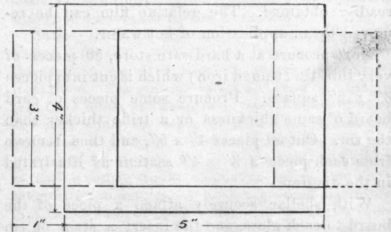
Next procure at a hardware store, 50 pieces of very thin tin (tinned iron) which is cut into pieces 3" x 5" square. Procure some pieces of card board of same thickness or a trifle thicker than the tin. Cut 50 pieces 4" x 5", and then remove from each piece a 3" x 4" section as illustrated in the diagram.
With shellac securely attach a piece of the board to each glass, and the insert a strip of tin in the space provided for it. In assembling this condenser, take twenty glasses and tins, and stack the one on the other so that the projecting ends of 1, 3, 5, 7, etc., will protrude at one end, and 2, 4, 6, 8, etc. at the opposite end. These glass plates should then be firmly tied in place with binding twine. Next do another twenty in the same fashion ; also the remaining two fives. Solder a heavy wire, which we will designate as a "lead," to the edges of the strips protruding at at each end, and have these leads long enough to permit connecting one condenser to another when desired.
When we connect these sections in series, the combined capacity is equal to the sum of capacities of each condenser, and when two condensers are connected in parallel, the combined capacity is equal to the product of the individual capacities, divided by the sum of these capacities. Also with three condensers in paralled we figure the combined capacity of any two, by this formula, and using this resultant capacity, continue the calculation with another condenser. By using different combinations in series and parallel, we are able to vary our capacity to quite an extent. Immersing these condensers in a liquid tight container of wood, or a jar, filled with insulating oil, like transil, parafine or linseed oil, renders them more efficient under high potential conditions.
Continue to:


My Books

