


A Mercury Interrupter
Description
This section is from the book "Amateur Work Magazine Vol3". Also available from Amazon: Amateur Work.
A Mercury Interrupter
George J. Atkins
Mercury interrupters have long been popular with users of high potential coils, but their cost, as compared with the simpler spring hammer vibrators, precluded their general adoption by amateurs.
Following is given a description of an efficient mercury-dip interrupter which was constructed from a cheap 2 1/2" door bell. The bell was striped of gong and cover, and the ball hammer that taps the gong, and then mounted edgewise on a piece of wood 3 1/2" x 2 1/2" attached by screws to the base board which is about 5" x 7". The rod carrying the hammer was left on the armature, in the fact the rod had to be lengthened by soldering on a short piece of brass wire.
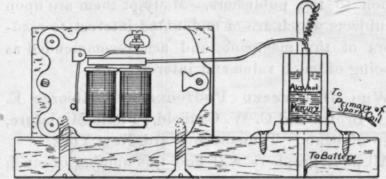
The dash pot which contains the mercury, is a piece of iron gas pipe about 1 1/2" long, and 5/8" diameter, and also fastened to the base board by fitting an iron cap to the lower end, or the bottom end may be plugged with a piece of wood. On the end of the brass wire soldered to the hammer rod, is fitted a cigar-shaped piece of brass rod of about 1/8" diameter. This shape was adopted to permit easy ingress and egress in the mercury. A half inch of alcohol is kept in the pot on top of the mercury when in use. One side of the primary battery, used to energize the primary of the coil, is connected to the iron dash pot, and the other side of the battery to the primary of the coil. The return end of the primary coil, is connected by means of a very flexible wire spring to the hammer rod of the bell, the spring being held by a brass rod, the lower end of which is driven into the base board and the upper end formed with a hook. A spring can be made by winding fine brass wire around a wire nail. A separate cell or two of battery is used to operate the bell armature, and adjustment is made by bending the hammer rod or "make-and-break" rod, so that the brass contact will be just outside of the mercury, but still covered with alcohol when the bell magnets are not energized.
When the bell armature operates, the contact piece enters well into the mercury, thus completing a circuit for the coil battery.
Continue to:


My Books

