


Soldering. II. Using Bunsen Burner And Blow Pipe
Description
This section is from the book "Amateur Work Magazine Vol3". Also available from Amazon: Amateur Work.
Soldering. II. Using Bunsen Burner And Blow Pipe
H. M. Chadwick.
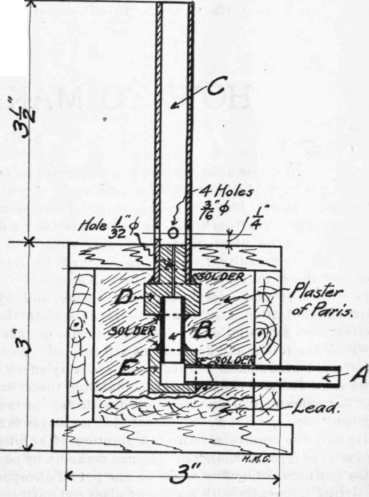
The Bunsen burner and the blow pipe are needed by one who would become proficient in the art of soldering. A cheap and satisfactory Bunsen burner may be constructed as follows:
Make a small box of the size shown in the sketch and fit it with a hard wood cover. This kind of wood is burned much less readily by hot solder than pine or whitewood. Pour a quantity of molten lead into the bottom of the box, being careful that the lead is not heated much above the melting point, as it will burn the wood if too hot. A handful of shot or iron filings may be used in place of the lead, the object being to weight the burner so that it cannot be easily overturned. A and B are pieces of umbrella tube, C is a piece of iron or brass pipe about 1/2 in. outside diameter, D and E are pieces of brass or iron, and are drilled to admit tubes A and B. Brass should be chosen by anyone not having a lathe, as it can be drilled with a twist drill, held in a bitstock. The position of D, which enters the pipe, C, should be turned or filed to a good fit. The small hole in D is about 1-32 in. diameter, and should be central with the pipe, C. Drill four 3-16 in. holes in pipe C, near the bottom, for the admission of air.
Solder all joints as noted in the sketch. This can be readily done with the soldering iron, carrying out the directions of the first article in Amateur Work for July.
Bore a hole in the side of the box to admit pipe A, and also one in the cover to fit closely around C. Mix enough plaster of Paris to fill the box, and pack it tightly around the base of the burner. Scrape it off flush on top and nail down the cover. The Bunsen burner is to be connected to an ordinary gas-burner with a piece of rubber hose. The blow-pipe is a necessary tool to be used in connection with the Bunsen burner. It is well to buy this article, as the manufactured ones are lighter and better than any that the amateur can make.
To produce a blast flame, put the large end of the blow-pipe in the mouth and turn it so that the small orifice points horizontally, quite close to the Bunsen flame and at a point about two-thirds of the distance from the base to the peak. Blow steadily, using the mouth as an air reservoir. After a little practice it will be found that air can be taken into the mouth with the tongue independently of the act of breathing, and that a steady stream of air can be forced from the blowpipe.
The flame thus produced will be seen to consist of two portions, one within the other. The inner is called the reducing flame. It is the hotter of the two and is the one which should be applied to the article to be heated. The outer is called the oxidizing flame ; it will change to an oxide any piece of metal placed in it. The application of the reducing flame to metallic oxides will free the oxygen, leaving the metal with which it has combined.
The flame of the Bunsen burner is of the same nature as the blast flame, but it is not so hot and powerfu. since the air mixture is caused by the natural draft through the holes in the base of the burner.
Suppose we wish to solder together two small washers in order to get one of double thickness. In this •case the blowpipe will not be needed. Clean each piece carefully and brush on one side with flux. Cut a small piece of solder from the stick, place it on one of the washers and hold this in the Bunsen flame with a pair of pliers. The solder will melt and run all over the washer in a thin film. If too much solder has been used, brush off the surplus before it can harden.
Now hold the two washers with the trimmed sides in contact, in the flame, pressing them together with pliers or hand vise until the solder is thoroughly melted and the surfaces appear to adhere. Remove them from the burner, keeping up the pressure on the pliers until the solder has set. Clean the bits of solder from the edges with a file or scraper. If the job has been well done only a thin, silver line will mark the joint.
Pieces to be soldered together that cannot be held with pliers or hand vise should, it possible, be wired into position, or, if wiring is impracticable, press them into a mass of adhesive substance made of plaster of Paris and clean sand mixed half and half with water, of course leaving exposed the parts to be soldered. Sometimes putty will answer this purpose. Again, certain articles may be held by nailing them to an asbestos covered wooden block or piece of pumice stone. Whatever method is used, all contact surfaces of any size should be thoroughly tinned before fastening.
It is convenient to have the burner connected to the gas supply by a long hose so that it can be held in the left hand and moved to any convenient angle, while the blowpipe and blast flame are directed with the right. The flux may be removed from soldered articles by boiling them a few minutes in weak sulphuric acid.
To use the blast flame successfully only requires practice as the solder follows a clean joint very readily.
Continue to:


My Books

