


Chemical Fire Extinguisher
Description
This section is from the book "Amateur Work Magazine Vol3". Also available from Amazon: Amateur Work.
Chemical Fire Extinguisher
William K. Slyke
If there is any place where fire is likely to occur it is in the amateur's workshop, especially when he is experimenting with combustible chemicals, and if it should start from oil, naphtha, benzine, tar, varnish and similar inflammables, water has little or no effect. The Chemical Fire Extinguisher, however, makes short work of such fires. The stream from it is mainly water impregnated with a chemical gas. This gas is carried with the stream and has an effect on the fire independent of the actual stream itself. To make such an extinguisher is not a hard task, the hardest part being the tank, which should have a capacity of about three gallons, although smaller ones can be made. The one here described is of this size, made from about No. 10 gauge copper plate and must stand at least 150 pounds pressure to the square inch, the stronger the better. The seam of the tank should be riveted and soldered, as should also the top and bottom. Tanks of the required size can be made up at any plumber's supply shop.
In addition there is also needed a 2 1/4 in. brass coupling and a brass plug to fit the coupling. The coupling should be cut in half with a back saw, as it is too long ; the other half can be used for another extingusher. In the centre of the top of the tank cut a hole large enough to admit the coupling snugly ; have about 1/2 in. of the coupling on the outside so as to solder it in the tank which will make a good strong job.
Next, get a bottle capable of holding four fluid ounces of sulphuric acid. This bottle should be narrow enough so that after it is in the holder it will slip easily into the tank through the opening in the coupling.
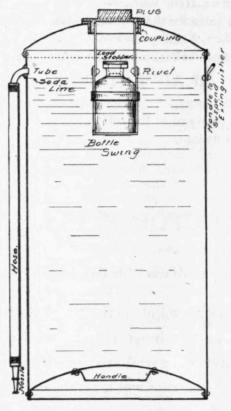
From the brass plug a holder must be suspended to hold the bottle. Cut a circle in brass 1/16 in. thick, a trifle larger than the bottom of the bottle. No dimensions can be given, as the bottles will no doubt differ somewhat in size and shape. Then cut two strips of brass 1/2 in. wide and 1/2 in. longer than the length of the bottle. This extra 1/2 in should be turned at right angles to allow the strips to be soldered to the round piece of brass. At the long end of these strips and about 1/4 in. from the end, drill a 1/8 in. hole. Solder these strips to the round piece of brass. Half way from the top of these strips solder another strip of brass 1/2 in. wide, forming a circle of the same diameter as the bottom circle; this will keep the bottle from falling out. See Fig. 1. Make two more strips of brass 1/2 in. wide and about 2 1/2 in. long, turn in 1/2 in. to allow a good soldering surface, as these ends are soldered to the under side of the plug. In the long ends of these two strips bore 1/8 in. holes. A copper rivet is now passed through the hole in each of these strips, as shown in Fig. These should not be riveted too hard, as they are to act as a hinge, allowing the plug to be turned back so that the bottle can be inserted easily. Next, make a lead stopper for the bottle: this should fit very loosely, so that if the bottle were tipped neck down the stopper would easily fall out.
On the side of the tank 1 in. from the top, drill a hole and insert a short piece of 1/2 in. brass tubing bent to form an elbow and soldered in place as in Fig. 1. Slip on a piece of 1 in. rubber hose about the length of the tank. This hose should be of good quality and strong enough to withstand the required pressure of about 80 or 90 pounds. An excellent way is to wind electric tape around the outside. To the free end of the hose attach a small nozzle with an 1/8 in. outlet. This hose should be fastened very securely to the tank and nozzle with several turns of copper or brass wire. The extinguisher is charged asfollows : Fill the tank with water within four inches of the top, into the water dissolve 1 1/2 lbs. of bi-carbonate of soda, which can be procured at at any drug store. Fill the bottle with 4 fluid ounces of sulphuric acid, leave the neck-of the bottle empty, insert the lead stopper and place the bottle in the holder ; then insert the bottle and holder in the coupling in the top of tank and screw down tight. A leather washer should be placed on the plug. The plugs should be of the shape shown in the drawing. To the sides of the tank should be soldered a handle for carrying and hanging up. There should also be a handle on the bottom of the tank' To operate the extinguisher it is only necessary to carry to the fire and turn it upside down, using the bottom handle to hold it and direct the stream, which will be very powerful. It will be seen that when the tank is turned upside down the plug will fall out of the bottle, thereby allowing the acid to flow into the soda solution. As soon as the two liquids meet carbonic acid gas is generated in quantity, forcing the water out of the nozzle with great force; the water is also impregnated with this gas, which acts as a blanket to the flame. When inserting the bottle in the tank see that the neck of the bottle will be above the soda line. The bottle holder should, if convenient, be tin plated on the inside. The extinguisher should be charged and discharged at least once a year cleaning all the parts before recharging. The extinguisher should hang in a central location easy of access at all times.
Continue to:


My Books

