


Elementary Mechanics. VII. Fluids
Description
This section is from the book "Amateur Work Magazine Vol3". Also available from Amazon: Amateur Work.
Elementary Mechanics. VII. Fluids
J. A. COOLIDGE
All substances that flow are called fluids, whether they be liquids that are heavy like water, and that exert a noticeable pressure because of their weight, or gases like air, whose weight is not so apparent, and yet flow more readily than liquids and exert pressure everywhere.
The fact that the air that escapes so easily from the tires of our bicycles does not fly off into space but remains near the earth's surface, shows that it has weight just as all other matter, and consequently exerts a downward force.
We must start with this law: - That fluids exert a pressure in all directions, and that at any given depth in a fluid the pressure is equal in all directions. This may be seen by a simple experiment. Take a common vegetable can and punch small holes, one in the bottom and one or two more at different depths In the side; then thrust it quickly, with the open end up, into a pail of water and it will be seen that the water spirts in through all the holes, but with greatest force through the one in the bottom. The water presses in all directions and has greater pressure the deeper we go.
For our apparatus we need a long necked bottle about 4 in. long and 2 in. diameter, a cork stopple, about 3 in. of rubber tubing 1/4 in. diameter inside, 3 in. glass tubing of same diameter, and a file. We must now cut off the bottom of the bottle. This is not an easy task, but with care it can be done successfully.
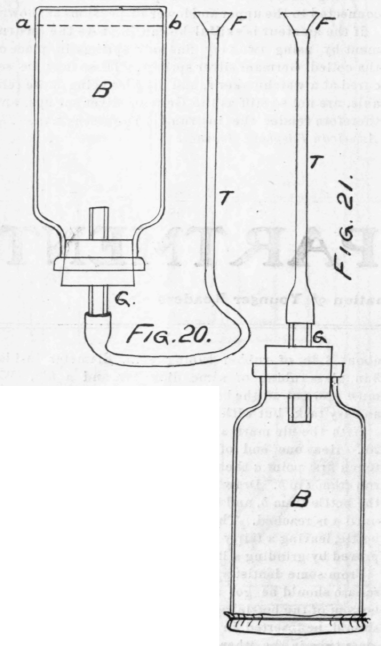
With the file mark a deep scratch mark (see aft, Fig. 20). Heat one end of a poker red hot in the stove, touch first point a then point b, causing a fine crack to run from a to h. Draw the red hot poker slowly around the bottle from 6, and this crack will follow the poker until a is reached. The bottom will now come off the bottle, leaving a fairly smooth edge. This can be improved by grinding a little on a whet or grindstone.
From some dentist a piece of thin sheet rubber 3 in. square should be got and tied with a thread over the bottom of the bottle, as in Fig. 21. A small funnel, F, should be inserted in one end of the-tube, and the glass tube in the other end and then through the cork of the bottle. A hole in the cork for the glass tube may be made with a round file. The whole apparatus will look like Fig. 20 when the bottle is inserted, or like Fig. 21 when the bottle is erect.
Experiment XV
Fill bottle, tube and funnel full of water and hold as in Fig. 21. Hold F on a level with the top of the bottle and slowly raise it ; as it rises the rubber sheet bulges out, showing a constant increase in the pressure upon it. Keep F one foot above B and notice the curve of the rubber ; turn the bottle on its side and observe again. Turn the bottle as in Fig. 20 and keep F one foot from B. In all these we shall find the pressure the same and that the law of " pressure being equal in all directions " is true.
Experiment XVI
Take the funnel out, hold the apparatus as in Fig. 20 and pinch the rubber between thumb and finger at F. Holding this in one hand, raise the bottle about two feet above F, and then let a little water escape at F. We then have an illustration of a water system. B is one reservoir ; F the end of a pipe which, after passing under ground through the streets, terminates in a faucet in a house. The higher B, is the faster the water flows. Lower B and see that when the water is on a level with F no water will flow. The distance vertically from F to B is known as the "head" of water. It is easily seen how necessary it is to have a reservoir in a high place in order to make the water have head enough to flow to all the houses. In some cities water has to be carried many miles in order to find enough difference in level to give sufficient pressure. Ask any plumber to explain to you the pressure gauge with which he tests the water faucets.
About 1648 Pascal learned that if a certain pressure were exerted on a part of the liquid in the interior of a vessel filled with a liquid, every other equal part received the same pressure. He took a strong cask, fitted a tall tube into its head, and then filled the cask and tube with water. Where the tube entered the head of the cask there was a pressure of the weight of the water in the tube. If the tube had an area (or cross section) of .5 sq. in., every other equal portion of the inside of his barrel had an equal pressure. He found the large area inside his barrel suffered so much pressure that his cask burst.
Experiment XVII
Set a box X with a ruler R tied to one side as in Fig. 22. Cut a thin disc of wood, D, glue a cork, L, to this piece of wood and a long bristle or broom straw, P, to the cork. Cut a piece 4x4 in. from a 2 in. plank, and with an extension bit bore a hole, 0, large enough to hold the neck of our bottle and £ in. deep. With bit 1/2 in. diameter, continue this hole, S, nearly to the bottom and bore a hole, V, in the side to meet S. With tube and bottle filled with water remove funnel, slip the block, K, over the tube and neck of bottle and insert in position as seen in Fig. 22. Replace the funnel, F, and place disc, D, and pointer, P, on top of the rubber sheet, B. Place the box with ruler, R, about 1/8 in. from P, so that any rise or fall in B can be measured. The rise in P will give us the means of measuring any increase in pressure on B.

Start with F and B on the same level and note the position of P . Raise F three inches. Does P rise ? Raise B three inches more and record any change in P. Continue taking as many readings as possible. Do not be disappointed if the increase in each new trial is not exactly uniform. The sheet of rubber prevents perfect results. Enough if we find an increase of pressure at B for a rise at F. What causes this pressure? Can it be the trifling amount of water in the tube F?
Experiment XVIII
Arrange the apparatus as before, only put a 4 oz. weight on D. Note the position of the pointer when F is three inches above B. Place an 8 oz. weight instead of the 4 oz. weight on D and raise F until P stands where it did before. Try a pound weight on D and raise F until P is in the same place. Manifestly it is not the extra weight of water in F, for that amounts to only a small fraction of an ounce for a rise in F of three inches. Recall Pascal's barrel and you have the explanation. If the tube is 1/4 in. diameter and Fis raised four inches, the increase in pressure down the tube and upon the opening into the bottle at T is only about .1 oz. But this pressure is on an area of only about .Oo sq. in., and this is transmitted to every equal area of B. If, instead of a rubber tube, we had- one of metal entering a metal cylinder instead of a bottle ; and if, instead of pouring water into a funnel, a piston were forced down F, the water would be forced into the larger cylinder. Now replace B with a large piston and we have the essential parts of a hydraulic press. A frame work above B must hold the substance to be compressed, and the piston at F must be fitted with a lever or pump handle. With such a press a tremendous power is gained, a force of 20 or 30 pounds often producing a pressure of 8 or 10 tons.
Continue to:


My Books

