


How To Build A Sail-Boat. IV. Fitting the Deck and Cabin
Description
This section is from the book "Amateur Work Magazine Vol3". Also available from Amazon: Amateur Work.
How To Build A Sail-Boat. IV. Fitting the Deck and Cabin
CARL H. CLARK
Fitting the step for the mast will be the next thing to do, as it is more easily done now than after the deck is laid. This step is a piece of oak, or other hard wood, about 5" wide and 4" thick, and long enough to cover the distance from the stem to the centreboard logs. Its forward end is cut to fit over the end of the stem, and the after end should be fitted down between the centreboard logs. Notches are cut in it for the floors, and it fits down solidly on the keel. It probably cannot be bolted now as the foundation is in the way. The holes should, however, be bored and the bolts driven later. The bolt at the forward end passes through the end of the stem.
The clamp streak is next to be fitted. It is about 2 1/2" x 2" amidships, and is tapered at the ends to about 2" x 2". It runs from the inside of the stem to the sternboard, being riveted to the frames 1 3/4" down from the top, to allow the deck beam to rest upon it. It should be fastened with J" or 5-16" rivets driven from the outside, with the head countersunk and headed over a washer on the inside. Where these clamps come together at the stem they should be joined together, and a three cornered piece worked on top of them and riveted through; the top of this piece should be flush with the top strake so that the deck plank will lie upon it. See Figs. 13 and 14.

At the sternboard a knee or corner brace should be shaped to fasten it securely. At the same time a knee should be fitted to fasten the bilge stringer to the sternboard. The plan, as shown, includes a small cabin large enough for two persons to sleep in. It is not, however, necessary that this cabin should be built, as if desired, it may be omitted, and the coaming carried around forward and the boat left open. If the latter method is adopted, the forward end of the standing room should be just at the end of the centreboard casing. The forward upright should be left long and be fastened to the deck above as a support both to it and to the deck. The coaming should be figured to fasten on the after side of this upright.
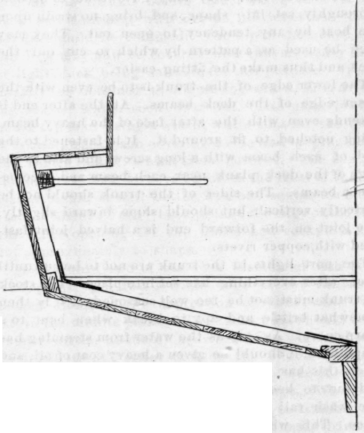
The consideration of this point is necessary at this time, as the deck beams are the next thing to be put into place and the cabin calls for a different arrangement than if without it. With a cabin the work is as follows; - The deck beams are 1 3/4" x 1 1/4" and are tapered at the ends to 1 \" x 1 1/4". They are cut with a "camber" or round up of 4" in 7 1/2'. All the beams are cut to the same curvatures and the under side is tapered off towards the ends. The beams forward, are laid against the after side of the frame, and those aft are laid against the forward side of the frame, resting upon the clampstrake.
The beam at the forward and after ends of the house and the one at the after end of the standing room are 2" x 2". The beams rest upon the clamp strake, which is beveled off, if necessary, to give them a good bearing. They are then riveted or bolted to it with 1/4" rivets. It is also advised that a large nail or a rivet be driven through the end of the beam and the end of the frame. This is not customary, but is considered advisable as making a rather stronger piece of work. The partial beams along the cabin and standing room may have their inner ends supported temporarily by a ribband placed along under them and shored up from below until the deck is laid and they are self supporting. The heavy beam at the after end of the house should extend across the boat, and be cut out later to allow access to the cabin. The three heavy beams at the forward and aft ends of house, and the after end of standing room, are to be placed 1/2" away from the frame, a small piece of 1/2" stock being placed between them and the frame.
The beam which is cut by the mast is mortised into a piece of 1 1/4" plank running from beam to beam, as shown in Fig. 14. This plank is 8" wide and has its ends halved to fit corresponding rabbets formed in the beams. These rabbets must not be very deep as they take away from the strength of the beam. The plank is to be fastened to the beams by rivets or screws. This plank also helps to support the mast and needs, therefore, to be well fastened. For cutting these beams a pattern can be laid out and used for all, regardless of their length. The curvature is supposed to be the arc of a circle, but by careful work, a batten can be bent to give the curve sufficient accuracy.

There are three deck knees on each side, worked as shown in Fig. 14. They are placed against the beam and on top of the clamp strake and fastened with rivets. A piece of wood should also be placed between them, and the side planking, and a couple of rivets put through. The office of these knees is to strengthen the deck structure, and prevent the boat from twisting or wringing. Before laying the deck the bulkheads at the forward end of the cabin, and the after end of the standing room, should be set up. as it is much easier to do it now than later. The partitions are of i" matched stock. There should be just space for each board to fasten to the after side of the frame at the bottom, and to the forward side of the beam at the top. The several boards should be nicely fitted to the outline of the frame, and strongly nailed, as these bulkheads are a very valuable stiffener to the boat and help to keep her in shape. An opening should be left in each, to be fitted later with a door.
The deck is 3/4" thick. It may be either covered with canvas, or left bright and varnished as preferred; the former is most easily kept in order, but the latter adds greatly to the appearance, although it requires some attention to keep in good condition. The description of the canvassed deck will first be given. The planking should start at the middle, where a single wide board should be used. It should be about 12" wide and 7/8" thick, as it has to be cut for the mast hole. Tongued and grooved stock of pine is to be recommended for the remainder of the decking. It is laid with the beaded side down, to leave a smooth upper surface, as any ridges are likely to cause wear of the canvas. Small headed nails are used to fasten the decking, and they are driven or set below the surface. At the edges the decking is finished off to the curve of the sheer strake and strongly nailed to its edge. The decking must make as good a joint as possible with the top strake, as any leak here will show when she heels over under sail. At the stern, also, the plank is trimmed off even with its after surface. The stock for the deck should in any case be thoroughly dry and well seasoned.
Continue to:


My Books

