


Receiver
Description
This section is from the book "Amateur Work Magazine Vol4". Also available from Amazon: Amateur Work.
Receiver
Since the electromagnetic waves to be received at a wireless receiving station are horizontally polarized at the earth's surface, an electrical oscillator whose axis is normal to the earth's surface is employed at the receiving station. This oscillator may either be connected to earth at its lower extremity or it may be connected to a device having reactance equal for all frequencies to the reactance of the vertical oscillator.
It is to be remembered in this regard that at the receiving station we are not concerned with what be-comes'of the energy which is dissipated by the reradi-ation of the energy from the receiving vertical oscillator.
We shall consider again a simple concrete case, and shall assume the elevated conductor to be a cylindrical copper wire of length a and radius p as in the case of the transmitter, though it must by no means be assumed that the elevated conductor at the receiving station must necessarily be similar to that at the transmitting station, or, in fact, that it must bear any resemblance to that at the transmitting station except in so far as its axis is preferably normal in the surface of the earth.
As in the case of the transmitting station, only one . simple arrangement of the apparatus sufficient to give the desired result will here be considered. By this ar-arrangement messages transmitted by means of persistent trains of simple harmonic electromagnetic waves of a predetermined frequency may be received to the exclusion of similar waves of materially different frequencies and without interference by impulsive waves. Such an arrangement of the circuits and apparatus is shown in the diagram, Fig. 11. In this arrangement the receiving device which is indicated at R is placed in a local circuit C3I3L3R3 which is made resonant to the frequency of the waves to which the station is intended to respond, and a second resonant circuit C2I1 L2I2 resonant to the same frequency and called a "weeding-out circuit, " is interposed between the first mentioned circuit and the vertical oscillator.
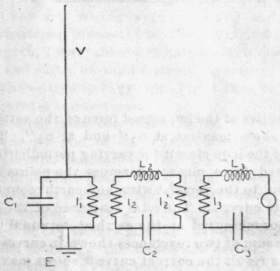
Fig. 11.
The branch circuit, consisting of the coil I1 and the condenser C1, is not, when taken by itself, resonant to the same frequency as the other local circuits, but so proportioned that when connected as a branch circuit, forming a part of the vertical oscillator system, the latter shall respond most energetically to persistent trains of waves of that frequency falling upon the vertical wire.
The way in which this is accomplished is perhaps more easily seen by a graphical demonstration than by the use of the analytical solution, though the latter is by no means difficult.
The curves in Fig. 12 illustrate the point in question. Curve 1 represents the reactance of the vertical wire measured at the point of its attachment to the loop circuit, for varying periodicities of the impressed force. It will be seen that the periodicity of the fundamental of the vertical wire at the point n1", where the reluctance first vanishes. The first even harmonic is at n2", and the periodicity of its first odd harmonic is at n3", where the reactance again vanishes. Normally, therefore, curve 3, which is the current curve for varying

Fig. 12.
periodicities of the impressed force on the vertical wire would show maxima at n1 and at n3". The reactance of the loop circuit for varying periodicities of the impressed force, measured across the points of its attachment to the vertical wire and earth connection is shown in curve 2. The total reactance of the vertical oscillator measured at the earthed terminal is the algebraic sum of two reactances shown incurves 1 and 2, and as a result the current curve 3 shows maxima, not at n1" and n3 ", but at periodicities n, n" and at a periodicity slightly higher than n3".
These are the points at which the reactance of the loop circuit is equal, but opposite in sign, to that of the vertical wire.
The periodicity of the local loop circuit per see is n1', and for this periodicity the current in the vertical wire is practically nil.
The "weeding-out circuit" and the circuit containing the receiver are both resonant to the periodicity n, so that for persistent trains of waves of that periodic-ty the energy of the oscillations set up in the vertical oscillator is transmitted directly to the receiver, but persistent trains of waves of other frequencies, either produce but slight response in the vertical oscillator or else produce oscillations of the periodicity n", or of a periodicity slightly higher than n3". To such period-icty the "weeding-out circuit" and the circuit containing the receiver are extremely irresponsive so that the receiving device receives but an inappreciable amount of the energy of the waves.
In the case of impulsive waves the vertical wire tends to respond only to its own natural rates of vibration as affected by the loop circuit, that is to say, it tends to oscillate at periodicity n" and to upper harmonics. Such waves acting on the vertical wire, have little tendency to develop oscillations of the natural period of the loop circuit as affected by its connection with the vertical wire, namely n, and the receiver is, therefore, also protected from the effects of such impulsive waves.
All that has been said regarding the effects of elec-static and magnetic hysteresis in the description of the transmitting station applies with added force to the apparatus at the receiving station. It is, in fact, much more important to exclude the effects of hysteresis-from the receiving circuits than from the transmitting circuits, and it may be laid down as an important rule that under no circumstances shall solid or liquid dielectrics be used in the receiving circuits.
Moreover, the injunction in regard to making the mutual inductance small between oscillators at the transmitting station applies in the case of the resonant circuits at the receiving station, since if the mutual energies of the related resonant circuits be not small compared to their self energies, the resonant circuits will modify one another's natural periods and each circuit will respond to more than one periodicity.
So great is the selectivity of resonant circuits constructed of air condensers and properly designed coils that there is no difficulty in adjusting such circuits to resonance for a given frequency with an error of less than one part in 3000.
The importance of the " weeding-out circuit " at the receivingstation becomes apparent when we observe that the selectivity of the vertical oscillator is greatly diminished by the dissipation of energy, which results from the reradiation of energy by that oscillator and that the selectivity of the resonant circuit containing the receiver may be greatly diminished by the energy absorbed by the receiver and utilized in its operation - -"Electrical Review. "
Continue to:


My Books

