


How To Make A Support For A Flower-Pot Or A Flower-Stand
Description
This section is from the book "How To Make Common Things. For Boys", by John A. Bower. Also available from Amazon: How to Make Common Things.
How To Make A Support For A Flower-Pot Or A Flower-Stand
Design three or four uprights, or make a copy of Fig. 116. Bind the upper part to rings the shape of any flower-vase you wish to form the top of your ornament; then as the stem of this must be stronger than that of the candlesticks, you must bind the ribbon upright to a small iron rod. If you have three sets of scrolls, you must get a smith to beat you a round iron rod into a triangular rod. This rod may be made long enough to reach to the same level as the scroll-work forming the feet, for it will give the stand additional strength. The spaces between this and the outside feet can be filled in with elegant little scrolls, which will add ornament and finish to the whole.
In Fig. 117 we give a design which is more ornamental, but which we think will not be more troublesome to make than the last described. There are somewhat more details in it, but when these are worked out separately, we think you will be able to put the various parts together. The sketch we give is from an actual piece of work made under the supervision of an art metal worker. The triangular pieces, bent with the broad edges outwards give strength and stability to the whole, and you may find it advisable to make them of wider strips of iron.
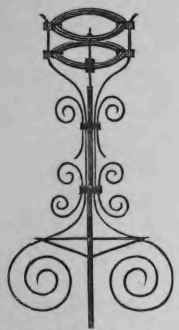
Fig. 116 - Design for Flower-stand.
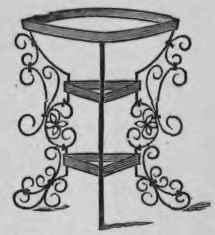
Fig. 117. - Ornamental design for a Flower-stand.
Lamps for suspension may be made by cutting squares of glass of any tint, size, or shape. Fit a frame top and bottom, and at each corner carry up a strip of scroll-work, or a plain strip, as shown in Fig. 118; from each corner of which carry up a length of scroll-work, or some short pieces well fastened together, so as to form a strong chain.
With stouter iron for the frame work, much larger and stronger objects may be made. We hare seen elaborate stands containing a methylated spirit-lamp and a branching hook above, on which a kettle has been hanging, forming a neat and useful ornament With a frame of ¼ inch iron, a useful fire-screen can be made, and such iron may also form the backbone of brackets. This iron can be twisted and worked cold. If you take a square bar, and put it into the vice, screw it up very tightly, so that the vice-chaps take the faces of the bar quite flat, you may by means of a square-faced wrench twist the iron into a screw-like form. This makes it look lighter than it would if it were wrought on a square bar throughout its whole length. Now supposing you want to make a bracket. Take a piece of iron ¼ inch square, bend it to a right angle, then turn up some scrolls, and fill in the angle, as in Fig. 120. Two other sets of scrolls on either side sometimes add to its ornamental qualities.
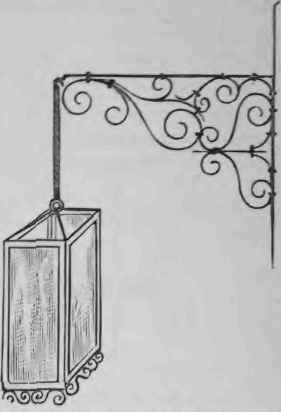
Fig. 118 - Suspended Hall-lamp.
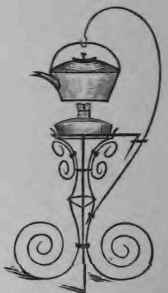
Fig. 119. - Kettle- and Lamp-stand.
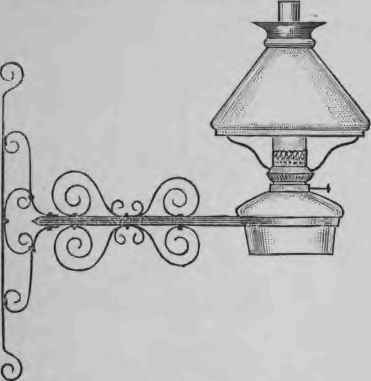
Fig. 120. - Bracket-support for Lamp.
Candelabra of two, three, or four branches may bo worked out. Brackets and bookshelves can also be arranged, by means of wood-work shelves screwed on to ornamental scroll supports.
These ornaments can be blacked, covered with enamel paint, gilt, or bronze, to suit the taste of any persons, or to match any other suite of ornaments, or they may be left plain.
Continue to:


My Books

