


How To Make Brackets
Description
This section is from the book "How To Make Common Things. For Boys", by John A. Bower. Also available from Amazon: How to Make Common Things.
How To Make Brackets
Corner brackets are variously made. Some are merely pieces of wood cut as a shelf to fit a coiner, with or without more support than nails driven into the wall, or lugs screwed to the shelf, and nails driven through the holes prepared, into the wall; or they may be made very ornamental and tasteful, according to the skill and patience of the workman. Suppose we want a plain bracket. Take a piece of ½ inch white pine; cut two sides at right angles; let the sides be from 6 inches to 8 inches deep according to size you require. This must be regulated by the corner you have to fill, or the object you have to put on the bracket. Now describe a part of a circle in the wood, by opening the compasses on a rule to as many inches as you want the depth of your bracket to be. Carpenter's compasses are best for this sort of thing; they differing by being heavier and stronger than those you use for your geometrical drawing. They also have a tongue fixed to one leg, which passes through a slit in the other, and a screw, so that a given distance can be taken and kept secure for any length of time. Of course you can do without them, for you can draw your figure out on a sheet of paper, cutting it to size and shape, from which you can afterwards mark out the wood. Now draw out the upright piece for the central support, as in a, Fig. 79, where the various portions are shown. The support can be fixed to the shelf (b) by screws or brads; or if the shelf is large and heavy, by French nails. You can stain and varnish; or before doing so, put a pattern, on both sides of the upright and under part of the shelf, according to the instructions already given.
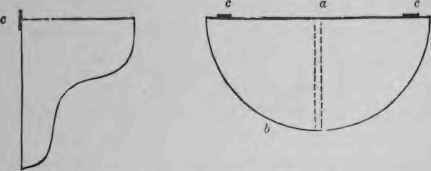
Fig. 79. - Sides and top of Bracket.
Sometimes brackets are made with two upright pieces, to go flush with the wall and the shelf at the top. In this case you must cut two pieces instead of one; both can be cut together by being held in a vice, as we have already mentioned. The methods of hanging the brackets to the wall is generally done by screwing small iron or brass plates called "lugs," c, to the upper part, and through holes in these nails are driven to hold them to the wall
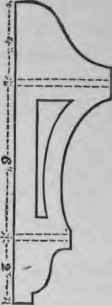
Fig. 80. - Open Bracket for two shelves.
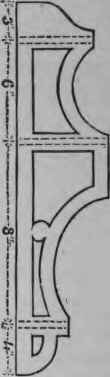
Fig. 81 - Open Bracket for three shelves.
Sometimes it is desired to have a bracket of more than one shelf. We give a design for one of two shelves, and of one for three. The designs for such things are numerous, so that we need only give one of each to show the principle on which they are made. With your skill in drawing and planning, and the knowledge you have now gained of manual work, you can design and fit up according to your own taste as many as you require. An ornamental bracket is a nice object for a present, if you wish to make one, or a pair for this purpose. Put your very best work into it. Only give presents of your very best.
In Fig. 80 we have supposed that the uprights should be of open work; they look lighter, and give you an opportunity of designing something light and strong. You must never allow your design to interfere with strength. In Fig. 80 you have a bracket with two shelves, and Fig. 81 with three shelves, and each with two uprights in open work, which should be made from slabs of wood about ½ an inch thick; and if of deal they can be stained and varnished in imitation of any hard wood. These patterns admit of being made into sets of hanging-shelves as well as corner brackets. In both these, if made to go flat to the wall, a looking-glass may form the back between the two lower shelves.
Hanging-Shelves
With plain or ornamental sides, you see how easy it is to make a set of shallow shelves suitable for holding geological specimens, or shells, or samples of bric-a-brac. The strength in each case must correspond to the weight it is expected to support.
Light shelves of this description are frequently nude to stand on the top of cabinets, and for this purpose they should be made a little ornamental; the sides being wider below, and also the shelves. From what we have already said, we think you can design and make a set to suit almost any purpose.
Continue to:


My Books

