


How to Make Box For Window Gardening
Description
This section is from the book "How To Make Common Things. For Boys", by John A. Bower. Also available from Amazon: How to Make Common Things.
How to Make Box For Window Gardening
Zinc troughs make the most durable boxes for the cultivation of plants in window gardening, but flowers are frequently cultivated in boxes made of wood, and to make one of these we now give directions. Take the length and breadth of the window-sill to which you require to adapt your box. Give it a depth of from 6 to 8 inches. Take ¾ inch stuff; there is no occasion to plane the wood that is to go inside, but the outside is better for planing. Nail the pieces together to form your box; then the front and ends can be covered with ornamented tiles or with rustic work, or with a pattern stencilled in various shades of oak-stain, which can be afterwards varnished. To cover it with rustic work you require some dried branches about 1 inch in diameter for the outer work, and less than that for the inner work. Several designs may be adopted, but that shown in Fig. 74 is by no means a bad one, and is easily carried out.
First divide the front of the box into five equal portions; find the centres of each of these, then split carefully the branches to be nailed on, having previously cut them off into proper lengths, using the thicker ones for the outsides. Nail them on as shown in Fig. 74, then nail some narrower lengths in the same way inside, and then another row of still smaller. Then for filling in these spaces, split a number of branches and nail them within the diamond-shaped space, each piece upright, close together side by side. The design, if nicely carried out, is very neat and effective, and the front of the box will thus have three panels, in the centre of which a fir apple or rough knot can be placed. Then the whole can be varnished. We have supposed in this case that the bark has not been removed from the branches used. Such a box may also be fitted on rustic legs and used as a flower-stand for indoor purposes. In either case the box may be covered with "virgin cork," in the absence of branches of wood, and may be made equally effective.
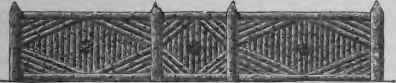
Fig. 74. - Rustic front to window-box.
In using the wood also, the design can be varied in many ways from that we have given, and be equally ornamental. A rustic pedestal for flowerpots may be made suitable for any niche or corner, constructed on the principle we have suggested. "Oak-wrongs," as they are called, can frequently be bought of gardeners, and may be ingeniously worked up together to form not only a very substantial but very ornamental piece of work. In the case of oak it is better to clear off the bark before making up. Cork has been largely used of late for ornamental rustic work, and it is very effective if tastefully employed, for arches, ferneries, and ornamental gardening. It can be nicely blended in with rockery, and can be used outside as well as inside a greenhouse.
An additional ornament to a fernery or a greenhouse rockery is a miniature fountain. This can easily be managed by bringing a pipe - small compo-tubing will do - from a cistern, which may be a tub or zinc-lined box, in the absence of the proper galvanized cistern. This must be situated somewhat higher than the jot forming the fountain is supposed to play. For you can see this is only an application of the principle that "all liquids maintain their level." If therefore your cistern is 8 feet above the floor of your greenhouse, the fountain issuing from it will tend to rise to the same height. It will not, however, reach quite the same height, but be somewhat lower, owing to the pressure of the air the jet of water will meet with in its struggle to rise. The smoother the pipe through which the water has to flow the higher will the waterrise, On the same principle a fountain may be contrived in a room. The cistern may be outside, and the tube from it brought in, under or between the floors. The basin into which it plays must have a waste-pipe, so that when a certain level is reached, the rest of the water may run away. A little ingenuity on your part will provide all these things successfully.
A miniature waterfall may be contrived on the same principles; but instead of a jet, the water must flow into a shallow trough, which can be made of some strips of slate or glass cemented together. The edge over which the water has to flow must not be quite so deep as the other. Of course a waste-pipe must be provided to carry off the superfluous water, and a channel for the water must be made of some waterproof material, so that the water does not get about everywhere. Fountain jets and devices can be bought at many plumbers, or jets can be made in glass, as mentioned in our chapter where glass-blowing comes in.
In this chapter we have given instructions relative to many things, but we think not too many, and in those we have given are suggestions for many more. We do not purpose going into directions for lathe-work; it would lead us into a wider field than this book aims at, and there are many books which give full directions for this class of work. A few hours spent in a workshop with an instructor will soon give you an insight into turning, which is a very fascinating and beautiful work ; and if you have any desire to be a good amateur workman, you will get all the practice you can at the "turning machine".
Chapter VIII. Indoor Work (Continued)
Very neat, pretty, and artistic work may be done by making plain, simple objects, and working on them a pattern by means of stain in various tints, and afterwards varnishing or polishing the objects.
Continue to:


My Books

