


Art Transfers
Description
This section is from the book "Things To Make In Your Home Workshop", by Arthur Wakeling. Also available from Amazon: Things to Make in Your Home Workshop.
Art Transfers
So popular has become the use of transfer patterns on commercial furniture and art wares that it is surprising more home workers have not taken advantage of this decorative vogue. Many, of course, do not understand how easily transfers are applied and still fewer amateur decorators appreciate the variety of brilliant effects made possible by these designs.
The decalcomania (de-kal-ko-mania) transfers, as they are called, have been used in the furniture trade for years to give expensive pieces the artistic finishing touches they need. Now they are available, too, in almost all department stores (usually in the paint or art materials departments), as well as in many neighborhood hardware, wall paper, and paint stores; and they are carried by the larger mail order houses. An almost endless variety of designs, motifs, colorings, shapes and sizes can be thus obtained.

Fig. 13. - The application of a transfer design of this type will give a piece of painted furniture a really artistic touch.
A transfer is nothing more or less than a paint film attached temporarily to a paper backing. When applied to enameled or lacquered furniture or other finished surfaces, the paper backing is moistened and removed, the paint film being left attached to the surface.
Some transfers are quite flat, while others have a texture and depth that make them appear almost as if hand painted. The best types have virtually the appearance of hand painting; you can see the brush marks!
The main use of transfers is, of course, on painted furniture, that is, on pieces which have already been finished with white or colored enamel or lacquer. They are used less often, but frequently with striking effect, upon natural finished furniture - pieces that have been stained and varnished. The many ways in which this can be done are best learned by observing closely good examples in a high class furniture store.
Among the most popular motifs are floral designs, which are appropriate for almost every decorative purpose. Ships are much in vogue at present, although their use is more restricted, as are bird and fruit designs. Many colorful nursery pictures can be obtained; these work wonders in brightening up both the furniture and permanent woodwork in children's rooms. Silhouette transfers fill the need for a contrasty, posterlike style of treatment (Fig. 13). Medallions are useful for more formal decorative work. Other classifications from which one can choose are conventional designs, which are for the more formal pieces; oriental designs resembling the work of Chinese and Japanese artists, especially desirable for red or black lacquered radio cabinets, secretaries, chests, telephone stands and so-called occasional pieces in oriental color schemes; landscapes, for rather ornate painted furniture in period designs, and Colonial designs, which are now enjoying great popularity.
If you decide which of these classifications is most appropriate for the piece you wish to decorate, you will find the process of choosing appropriate transfers will be much easier than if you make a hasty and haphazard hunt through the large variety of samples of all these types which you will be shown in any well-stocked shop.
In addition to these classifications, there is another type of transfer intended especially for use over natural finished furniture, which gives the effect of inlaid bandings and inserts. So perfect are some of these that it is almost impossible to tell them from actual inlays, although they can be obtained for a fraction of the cost and require none of the skill which genuine inlaying calls for.
When you have decided upon the type of design you wish, make up your mind as to the approximate size. It should be proportionate to the surface on which it is to be applied. The tendency is to select a design that is too small. The shape, too, should correspond to the surface on which the transfer is to be used.
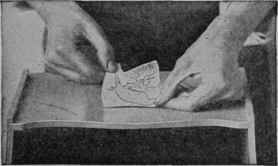
Fig. 14. - A center line on the back of the transfer is a great aid in placing it centrally and vertically.
Your good taste will govern in selecting the coloring. If you can take a small sample of the background color with you when buying transfers, it is a simple matter to choose.
Some articles can be decorated with almost any type of pattern. A magazine rack, for instance, would be in good form decorated with any motif with the exception, perhaps, of fruit. Breakfast sets are generally done with four corner designs. Card tables and other small tables often have a central design combined with corner pieces and occasionally a narrow border is run entirely around the table top or connected with the corner designs. Lineal borders are obtainable for this purpose in 2-ft. lengths.
You will find that the back of each transfer usually is marked with vertical and horizontal guide lines. These are to made on a varnish base also are usually excellent. A good grade of liquid glue is often used by home decorators because it is so convenient; its adhesive properties are entirely satisfactory, but there is some tendency for glued transfers to draw and pucker up while drying.

Fig. 15. - Varnish or other adhesive is applied to the transfer and allowed to stand until "tacky." aid you in centering the design and applying it exactly horizontal or vertical (Fig. 14). If there are no guide lines, trim the top of the transfer paper to a straight edge just above the design and mark the vertical center line.
Make careful measurements before applying transfer and do not rely merely upon your eye. The best design will not be satisfactory if off center or crooked.
A thin, quick-drying varnish is an ideal adhesive for transfers, as it is elastic and does not cause puckering. The various proprietary adhesive cements from the center outwards, with a rubber roller or a cloth.

Fig. 16. - The transfer is pressed down.
Apply a thin, even coat of the adhesive selected to the face of the transfer, covering every bit of design (Fig. 15). Allow to stand until the adhesive is "tacky" or sticky. Place the transfer on the surface to be decorated and rub down hard with a cloth or, preferably, with a rubber roller such as is used for mounting photographs (Fig. 16). Work from the center outwards to avoid wrinkling.

Fig. 17. - After being saturated with water, the paper backing is either lifted up or slipped off.
Next saturate the paper backing with lukewarm water. Wait about thirty minutes before doing this, however, if glue has been used as an adhesive. If any air bubbles are seen after applying the water, smooth them with the roller. Then lift or slide off the paper backing as shown in Fig. 17.
Clean the surface immediately by sponging with water (Fig. 18). In case the transfer has been applied with varnish, the water will not remove surplus deposits of varnish, so go over the entire surface a second time with gasoline diluted about 50 per cent with water. No hesitation need be felt in doing this if the surface, whether paint, enamel, lacquer or varnish, is thoroughly dry, as it will not appreciably affect its appearance. Even should the finish become streaked for some reason or other during the application of the transfers, it can be polished with furniture polish or wax to restore the luster.
It is important to wash up the surface at once after removing the paper backing beeause the gum remaining on the face of the transfer is otherwise almost certain to pucker and crack the design.
Even the best of transfers sometimes seem a bit temperamental and occasionally one may go wrong, but if reasonable care is used, there will rarely be any difficulty.
If one has had any experience in art work or decorative painting, it is often possible to touch up designs with artist's oil colors so as to bring out the high lights and shadows and tone down or change the colors, where necessary, to bring the design more in harmony with the body color. If well done, this makes the design appear wholly hand painted. It is frequently resorted to by professional furniture decorators.
Whether a protective coat of varnish should be applied over the transfers depends upon the individual piece, how it will be used, and the effect desired. If it is going to have any hard wear over the decorated surface, as, for instance, in the case of a breakfast table or the back of a chair, the transfer must be protected; otherwise the hand-painted effect will be most fully preserved by leaving the transfer uncoated.

Fig. 18. - The surface is cleaned first with clear water, then with gasoline diluted with water.
Varnish, when used as a protective coating, is generally applied with a small brush, following the outline as closely as possible. This gives a glossy luster to the design and changes the effect considerably. Clear brushing lacquer may be used and, as it has not so high a gloss, gives a more artistic effect than varnish; indeed, it is an ideal coating for this purpose. Clear lacquer does not, as one might expect without trying it, "pick up" the transfer colors or cause them to "bleed." Flat varnish also maybe used; it dries without gloss, but has little wearing qualities.
Sometimes a pleasing effect is obtained by coating the entire surface of lacquered articles with clear lacquer. One should always make sure of the effect in advance, however, by trying a small sample, as this treatment will change considerably the appearance of a colored lacquer finish. If the piece had been finished with enamel instead of colored lacquer, do not conclude that varnish can be similarly used over the entire surface, because it gives a distinctly yellow tone, especially over light and delicate tints.
After making a few experiments with decalcomania transfers, you will find you nave at your command one of the most inexpensive and attractive methods of decoration ever developed for furniture and craft work.
Continue to:


My Books

