


Gifts At Low Cost
Description
This section is from the book "Things To Make In Your Home Workshop", by Arthur Wakeling. Also available from Amazon: Things to Make in Your Home Workshop.
Gifts At Low Cost
Artistic and genuinely desirable gifts can be prepared at absurdly little expense if you know the secret. It is just this: Buy well designed but cheaply finished novelties and art wares, or else get entirely unfinished articles, and decorate them yourself by the methods just described or by any of those to be outlined in this section.
All manner of things may be decorated (Fig. 11). Vases, candlesticks, flower holders, bowls, book ends, plaques, boxes, door stops, salt and pepper sets, cake boards, wooden spoon and fork sets and the like may be found in ten-cent stores, variety shops and hardware and house furnishing stores. Wooden-ware, glass, pottery, china and metal articles may be purchased unfinished in artists' supply and department stores. And in every home there are already many objects waiting to be redecorated.
Polychroming is one simple and effective method of decoration. It is the application of a plastic composition, which is stippled into textured or relief effects and then colored, bronzed, and wiped off to produce a multicolored surface.
Various plastic materials are employed. Gesso clay or Italian clay, sold in small cans, is extensively used, as is plastic wall paint. A gesso preparation may be made by mixing together about ½ pt. whiting, ¼ pt. liquid glue, and 3 teaspoons each of varnish and linseed oil. The proportions may be varied slightly as necessary to produce a composition of good working consistency; it must be sufficiently stiff to stay put when modeled into relief effects.
The material is brushed on to the surface or applied with a knife. After it has set for a few minutes, it is stippled in various ways. A brush, spoon, spatula or paring knife may be used to produce scrolls and fanciful designs. Confectioners' icing tools or pastry ornamenting tubes are sometimes used for more elaborate designs.
When thoroughly dry. the surface is usually given a sealing coat of shellac or special size adapted for that purpose.
With some plastic compositions this is not absolutely necessary, but it is always a safe practice. It may then be given any color treatment desired.
A typical method is to give the surface a foundation coating of gold, silver, copper or green bronze, or a suitable tint of flat wall paint, enamel or lacquer, and then to use for the polychroming either oil colors, flat wall paint, glazing colors or the new brushing lacquers. The glazing colors are applied with a brush. Before they have commenced to set, they are wiped with a cloth from the high spots and other places, as may be de-sired. One or more colors may be applied and wiped off, followed when thoroughly dry with other colors handled in the same manner. One color peeps from beneath the edge of another, producing beautiful effects. Frequently the polychroming is completed entirely with bronze powders - first a foundation brush coat of gold, silver or any desired shade, then a coating of japan gold size, and a "patting" on of bronze powders of other colors with a piece of velvet.
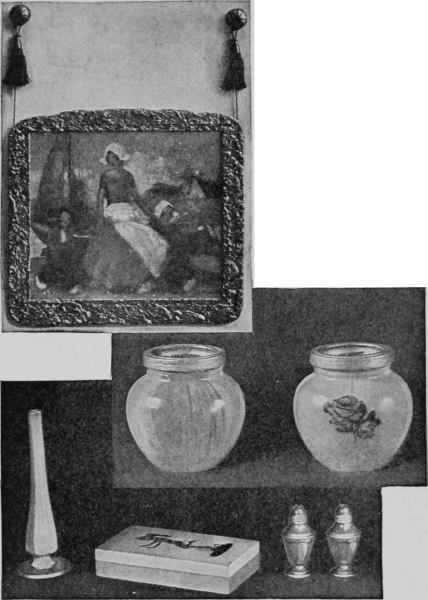
Fig. 11. - Wall plaque, made from a color print, covered with cheesecloth and shellacked so that it resembles an oil painting. The frame is polychromed gesso. Below : "Pour-finished" preserve jars, one with a transfer design, and other articles bought for ten cents each and lacquered in any colors.
"Pour finishing" is one of the newer forms of treatment, Brushing lacquer seems to be especially adapted for this work, both as to working properties and appearance. The only supplies necessary are several cans of lacquer of different colors and a drip pan, which may be any pan, plate, or other shallow receptacle.
The object to be decorated is placed in the drip pan and one color of lacquer poured over it so that it runs down the sides (Fig. 12). If the object is set up on a block a little smaller than its base, the color will drip off and not form a bead around the bottom edge. Before the color has commenced to dry, another color is poured on, or as many colors as may be desired, until the surface is entirely covered. The lacquer runs down in irregular streaks and stripes, blending in fanciful formations and producing the most exquisite effects.
A little variation of the treatment will cause a different appearance. For instance, if each color is allowed to dry until it becomes "tacky" before the succeeding color is poured, there will be less blending and a more definitely streaked effect. Still different blends can be made by those with freehand or china-painting experience by pouring on one or two colors and working up scrolls and other designs. Vases, cruets and bottles of artistic shapes also are sometimes decorated by pouring the lacquer into the object and twirling until the entire inside is colored; the excess lacquer is then poured out. By pouring in two colors, a unique streaked effect is obtained. The pour finish is not wasteful; surplus lacquer is poured back into the can. Vases so decorated cannot be used for flowers; standing water may loosen the paint.
Spraying allows the amateur to produce many shaded and stippled effects. Inexpensive sprayers for the purpose are - sold by some paint dealers, and an ordinary insecticide spray gun may be used.
Regular brushing lacquer may be sprayed quite satisfactorily with this equipment by reducing it from 1/5 to 1/3 thinner, which must, however, be made by the same manufacturer as the lacquer. Some practicing should be done to learn the manipulation of the sprayer, and the spray should be used rather cautiously.
Frosting is a pleasing effect, which may be obtained by blowing gold, aluminum, green or copper bronze powder from a paper onto an enameled or lacquered surface while it is still wet. On a lacquered surface it is necessary to work speedily before the quick-drying lacquer commences to set.
Texturing colored prints is another new idea. Fine prints such as are found in magazines or bought at a nominal cost can be given an appearance closely resembling that of a real oil painting.

Fig. 12. - How a preserve jar or any inexpensive piece of pottery may be decorated by pouring lacquer over it.
Lay the print, picture side up, on a clean, perfectly level surface, and place a piece of cheesecloth over it. Then apply a coat of shellac over the cheesecloth, brushing it out evenly and thoroughly into the meshes. As the shellac dries, it will cement the cheesecloth to the print. The texture gives a surprising softness and richness to the print and makes a truly artistic picture, which can be framed, passe-partouted or mounted on a plaque and polychromed, as desired. It may be used without glass, as the shellacked surface will permit wiping off with a damp cloth whenever necessary.
The cheapest grade of cheesecloth, very sleazy and with wide meshes, should be used. The better grades, which are closely woven, hide the picture too much. The cheesecloth should be shaken just before using to remove loose pieces of lint. In some cases the shellac "bleeds" the colors in the print and causes them to run a little, but this is seldom objectionable. The colors generally seem to blend together so that the effect under the meshing is quite delightful. If the picture docs not show through plainly enough, apply a second coat of shellac.
Continue to:


My Books

