


Dump Truck
Description
This section is from the book "Things To Make In Your Home Workshop", by Arthur Wakeling. Also available from Amazon: Things to Make in Your Home Workshop.
Dump Truck
The dump truck, Figs. 6, 8, 9, and 10, is the largest of the four toys. The chassis is built somewhat differently from the others, in order to allow the body to be raised to a better position for in. high, and 6 in. wide. The filler cap is a screw cap from a shaving cream tube, fastened to the block with a round-headed screw. Two green rhinestone buttons are set into 5/16-in. holes bored in the front of this piece for side lights, and a red one is set in the rear end of one of the chasis beams. The buttons are cemented in with shellac.
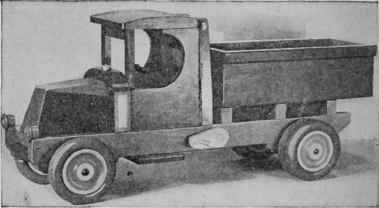
Fig. 8. - The dump truck has a foolproof elevating mechanism, the parts being a dowel, a spool, and a piece of tape dumping. A very good truck of this kind may also be built on one of the simpler chassis previously described.
The chassis requires two beamlike pieces 7/8 by 1 7/8 by 25 5/8 in. These are held 4¼ in. apart at the front end by a piece 7/8 by 4¼ by 11 7/8 in.; this runs to back of the cab. The dummy springs are spring-shaped pieces of wood screwed to the underside of the chassis as shown. Between the two front springs is fastened a piece 7/8 by 1 by 4¼ in. to represent the front axle, and between the two rear ones is a piece of wood cut from a piece 7/8 by 2 1/8 by 4¼ in. to represent the rear axle and differential housing (see Fig. 6).
The body rests on three cross members, notched out as shown. Two of them are 7/8 by 2¼ by 6 in., and the forward one is 7/8 by 1 3/8 by 6 in. The body is hinged to the rear crosspiece with a common steel butt hinge.
The running boards or steps are made by gluing and screwing a length of wood ¼ by 3 3/8 by 8 in. under the chassis.
The hood is shaped from a block 3¾ in. high, 4¾ in. wide, and 5 5/8 in. long. The radiator block is 1 1/8 in. thick, 4 5/16

Fig. 9. - Working drawings of the dump truck. Of impressive size, this truck is an exceptionally rugged toy for rough play.
The headlights are made of a spool as in the preceding models, and a green or yellow rhinestone button is pushed or cemented in each.
The cab consists of a front and rear piece 3/8 by 5 ¼ by 7 ¼ in., and two side-pieces 3/8 by 5½ by 7¼ in., cut with a coping saw. The top is made of a thicker piece of wood (7/8 by 6 by 6 in.), planed and sanded to give the characteristic curve at the top. The front end may be made, if preferred, by gluing and nailing two uprights to the radiator block with a cross member between to support the roof. The steering wheel and seat are made as before.
The hoist is made of two wooden uprights shaped and mounted on the chassis and to the cab back as shown in Fig. 10. Bolt holes are bored at the top for the bolt on which the spool pulley turns. The crank handle may be made of thick laminated wood or of soft wood.
The holes in it should be bored before the crank shape is sawn out; then the crank and shaft are glued in. Deep saw cuts are made in each end of the crank and part way into the dowels so that a piece of thin berry-box wood can be glued in each cut, across the grain, to prevent the handle from splitting. One end of a strong linen tape is screwed to the lower part of the front end of the truck body with short screws passing through a narrow strip of tin across the end of the tape, which also may be glued to the body. The other end of the tape is secured to the crank shaft, between the hoist, in the same way.
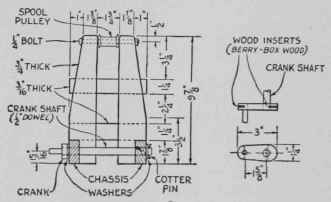
Fig. 10. - How the hoist (left) and crank (right) for the dump truck are made.
The body is a strong box of ½-in. wood, 4¼ by 6 by 13 5/8 in. in outside dimensions. The rear end is left open. A sliding tailboard fits in between narrow strips of wood, or slides may be nailed and glued in place so that this tailboard may be pulled up or removed for dumping. Along the top of each side-piece is a simple molding made of a planed strip of wood (see Fig. 6).
The wheels are 4 7/8 in. in diameter, of white wood, birch, or maple, turned to represent disk wheels with large truck tires, but excellent ones may be made of plain sawn disks. Notice that double wheels are used on the rear end (Fig. 6). These wheels are secured to the chassis by large, strong round-headed screws, two or three iron washers being placed between each wheel and the chassis, and one under each screw head.
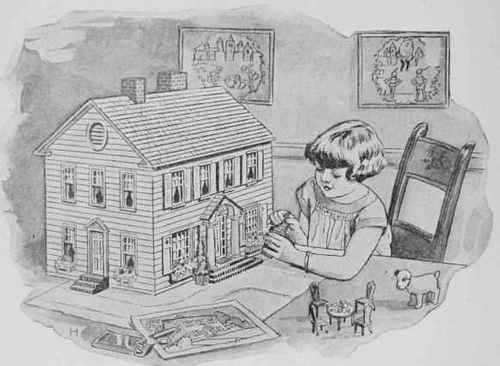
Fig. 11. - This doll's house is a realistic model of a fine Colonial home.
Extra strong axles may be made for this truck by using lengths of ¼ or 5/16 in. diameter soft steel rod to run across the chassis and through the wheels. Steel washers are used as before and the ends of each axle are riveted over to hold the wheels on, an iron washer being under each rivet head thus made and the wheel. In this event the wooden front and rear axles may be set forward slightly to clear the steel rod, or a hole may be bored clear through each to take the axle.
The chassis of the truck is painted Chinese red, as are the wheels, steering wheel, hoist, and headlights. The hood, radiator, cab, and body are painted black; the inside of the cab is jade green, and the inside of the body, khaki color. Silver paint is used to stripe the wheels, for the crank and pulley, on the sides of the radiator, front of the headlights, filler cap, and bolt heads on the hoist. The top of the scat inside the cab is painted black, and the tires on the wooden wheels, a dark gray or rubber color.
Continue to:


My Books

