


Fitting Up A Boy's Room
Description
This section is from the book "Things To Make In Your Home Workshop", by Arthur Wakeling. Also available from Amazon: Things to Make in Your Home Workshop.
Fitting Up A Boy's Room
A boy's bump of acquisition is immense. In the earlier years his pockets suffice to store accumulated treasures, but not so in his teens. No pocket has yet been designed that could accommodate a model cruiser or an electric derrick.
It is important that he should have a place to keep these possessions, many of them of his own construction, as well as a room for entertaining his friends. Boys certainly resent being shooed off into the basement or garage when two or three cronies come to see them. One way to keep young men contented at home is to give them a room, absolutely their own, and to have it equipped in a manner they appreciate. The design illustrated in Figs. 11, 12, and 13 covers about everything a boy from ten to eighteen could want - except, of course, a workshop, and that has been left out purposely, for it should be given separate and special consideration.
Although the plan is for a comparatively small room, the built-in features make it as convenient as much larger quarters. The double-deck bed has the advantage of occupying little space and at the same time will accommodate overnight visitors very comfortably. Besides, it is mildly reminiscent of a ship or a mountain cabin, and therein lies much of its attraction. Adjoining it is a roomy closet for a dresser. A screened vent in the ceiling provides ventilation.
It is assumed that the location is a corner room and that casement windows, opening out, afford good light and permit the room to be aired quickly. Unsightly shade rollers are eliminated by using monk's cloth curtains, substantially supported on rods independent of the individual windows.
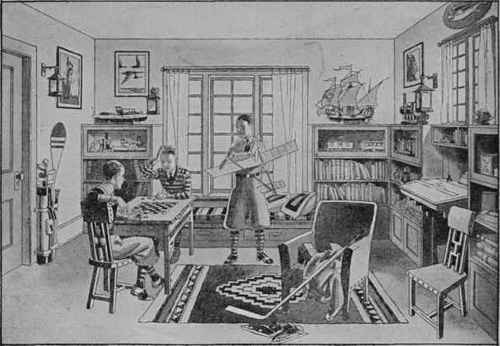
Fig. 11. - A real boy's room - one where he can have all of his treasured possessions and where he can entertain his companions. A room as carefully planned as this can be kept looking neat with little effort.
The low window seat with cushion is an invitation to read; books are conveniently at hand on either side. Below the shelves are cupboards, and the top shelves with their glass doors serve as exhibition cabinets for model boats, mechanical devices, and such items as the boy has built himself.
A drawing desk is an important feature. This also is built in, with space between it and the flanking bookshelves so that there is plenty of elbow room to use a T-square handily. The lid lifts up to give access to a compartment for paper and other equipment.
Behind the door to the hall is a rack for golf clubs, baseball bats, fishing rods, canoe paddles, and other sporting accessories. A special table is suggested, covered with Spanish leather to withstand somewhat rougher use than a polished surface showing the arrangement of the built-in beds, closet, window seat, desk, and other furniture.

Fig. 12. - A plan of the boy's room pictured in Fig. 11.
deserves. It is fitted with some drawers and a narrow space is provided for chess-or checkerboard. Two chairs in keeping with the design of the table are indispensable. When four play a game, the table is drawn up to the window seat, and the two straight chairs are used opposite. A large leather armchair is also desirable for reading and studying in the evening.

Fig. 13. - Double-decked beds save space and lend a picturesque note of the sea. How the joints are made.
Although the chairs and tables are of modernistic design and therefore expensive to buy, any young man skilled in the manual arts should be able to make them. Likewise the bracket lamps, of square pattern, made up of black sheet iron with strap-iron framework and pearl or opalescent glass.
The bed frame consists of four 4 in. square posts with sideboards rabbeted in and further secured with short cleats inside. A 1 by 3 in. piece along the bottom edge of the sideboards supports the slats or springs and mattress. Drawers are built under the lower bunk and a grille is provided for airing the space below.
The interior finish and decoration are, of course, matters of personal taste. With rough plaster walls a very light green tint would be effective in setting off weathered oak woodwork. A good Navajo or other Indian blanket would not be amiss on the floor, and by all means allow the occupant to put up all the relics he wishes on the walls; they are a part of his life and ideals.
Continue to:


My Books

